

Eviction Process in Kenya: A Landlord's Step-by-Step Legal Guide
TL;DR / Summary
The eviction process in Kenya has four legal steps: serve a formal notice to vacate, file at the correct tribunal or court, present your evidence at a hearing to get an eviction order, then let a court-appointed bailiff enforce it. You cannot change locks, cut utilities, or remove a tenant yourself, no matter how much rent they owe. Skip the process and you risk a lawsuit, not a solved problem.
Your tenant stops paying rent. You go to the property and they’re still inside. Bills are piling up, calls are being ignored, and your first instinct is simple: change the locks.
That decision is where most landlords in Kenya get into trouble. The eviction process in Kenya isn’t just about getting your property back. It’s about whether you do it legally, and the law is very specific about what “legally” means.
I once worked with a landlord who tried to remove a tenant after three months of non-payment. He didn’t serve proper notice. He locked the tenant out of the unit. Within days, the tenant had filed a case against him for illegal eviction. What should have been a straightforward rent recovery turned into a much bigger, much more expensive legal problem.
If you’re dealing with unpaid rent right now, that’s usually where this journey starts. This guide covers what comes next: the legal, four-step path to getting your property back.
Why Can’t You Just Change the Locks in Kenya?
You cannot personally evict a tenant in Kenya, no matter how much rent they owe or how much damage they’ve caused. Once a tenancy agreement exists, the tenant has a legal right to quiet enjoyment of the property, and only a court or tribunal can take that right away.
This is the rule to get straight before anything else. It doesn’t matter if your tenant owes a full year of rent, has trashed the unit, or has made every neighbour miserable. Changing the locks, removing a door, cutting off water or power, or sending someone over to “have a word” are all unlawful actions, regardless of how justified they feel in the moment.
Kenyan courts have consistently sided against landlords who take matters into their own hands. Legal guidance on unlawful eviction is clear that landlords who lock out tenants without a court order face real consequences: mandatory injunctions restoring the tenant’s possession, damages for distress, and even criminal liability if private enforcers are used to remove a tenant. Article 40 of the Constitution protects property rights, and Article 47 guarantees fair administrative action, which together mean due process applies even when a tenant is clearly in the wrong.
Your frustration as a landlord is valid. But the legal system has a defined path for it. Every other path is a trap that turns a bad tenant into an expensive lawsuit against you.

Dealing with a tenant situation right now?
Don't guess your next move. One wrong step (a lockout, a missed notice) can reset your entire case legally. At Simpl Property Management, we handle notices, documentation, and lease enforcement for landlords across Nairobi every day. Schedule a call and let's map out your situation before you act.
Phone: +254 768 855005
Email: info@simplproperties.co.ke
Step 1: Serve a Formal Notice to Vacate
A valid eviction notice in Kenya must be in writing, state a clear reason for termination, give a specific date the tenant must leave by, and be proven to have reached the tenant. A WhatsApp message or phone call does not count.
Every legal eviction starts with a piece of paper: a formal, documented Notice to Vacate. The notice needs to clearly identify the premises, state the grounds for termination, and be signed by the person issuing it, according to guidance from Muthii Associates on Kenya’s eviction framework.
Proof of delivery matters as much as the notice itself. Deliver it in person and have the tenant sign a copy, or send it by registered post. If you can’t prove the tenant received it, they can simply claim they never saw it, and you’ll be starting the process from zero.
What counts as a valid reason? Non-payment of rent is the most common ground. Breach of the lease, such as subletting without permission, ongoing nuisance to neighbours, or damage to the property, also qualifies. So does a genuine need to reclaim the property for your own use or for major renovations.
In estates and apartment blocks with shared amenities, unpaid dues can matter too. If you understand service charge obligations and tenant rights in your building, you’ll know whether piling arrears there strengthen your case alongside unpaid rent.
Notice periods depend on your lease and the type of tenancy. For monthly residential tenancies, one month’s notice is the general standard. For business premises protected under the Landlord and Tenant Act (Cap 301), a two-month notice period specifying the grounds is required under Section 7 of the Act. If you’re unsure which rules apply to your unit, check with a lawyer before you serve anything, because getting this step wrong resets your entire timeline.
One more critical detail: once you’ve issued that notice, stop collecting rent. It feels counterintuitive when someone owes you money, but accepting rent after the notice period expires can legally convert the tenant back into a month-to-month tenancy. If that happens, you’re back at square one. Good lease enforcement support exists precisely to help landlords avoid this kind of self-inflicted delay.
Step 2: File in the Right Tribunal or Court
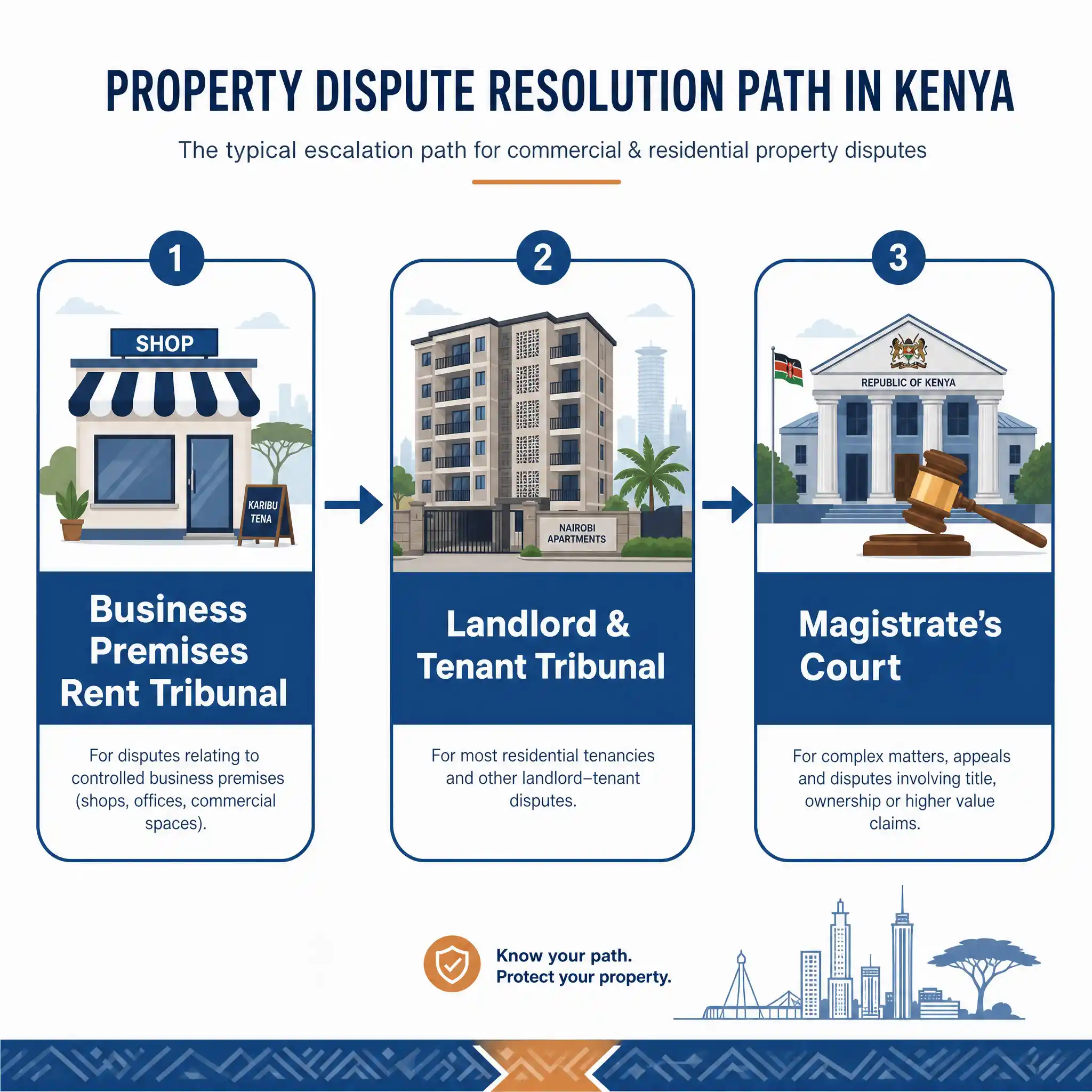
Filing in the wrong venue is one of the fastest ways to lose months on an eviction case. Kenya has three separate forums depending on the type of tenancy: the Business Premises Rent Tribunal for controlled commercial leases, the Landlord and Tenant Tribunal for most residential disputes, and the Magistrate’s Court or Environment and Land Court for higher-value or more complex matters.
Here’s how the landscape breaks down in practice:
Controlled commercial tenancies, such as shops, hotels, and restaurants with leases under five years and no opt-out clause, fall under the Business Premises Rent Tribunal (BPRT), governed by the Landlord and Tenant Act, Cap 301.
Most residential properties, meaning your typical apartment or house rental, start at the Landlord and Tenant Tribunal or the Rent Restriction Tribunal, depending on whether the tenancy is “controlled” under the relevant rent threshold. These tribunals exist specifically to streamline landlord-tenant disputes without clogging the regular courts.
Cases outside those tribunals, including higher-value properties, ownership disputes, or complex commercial matters, go to the Magistrate’s Court. These courts also hear appeals from tribunal decisions.
Get a property lawyer to confirm exactly where to file before you do anything else. It’s a small cost compared to refiling a case in the correct venue months later.
This matters even more for large mixed-use developments, like Nairobi’s NSSF Twin Towers, where a single mishandled commercial lease dispute can affect dozens of tenants at once.
Filing Your Case: What the Tribunal Actually Needs
Filing at a tribunal like the BPRT typically follows a structured process. According to guidance on BPRT filing procedure, you’ll need to submit a Reference (often on a prescribed form), a written application setting out the relief you’re seeking and your grounds, and a supporting affidavit describing how the dispute arose. If the situation is urgent, an advocate can attach a Certificate of Urgency to request interim orders while the case proceeds.
Your evidence pack should include the tenancy agreement, the notice to vacate and its proof of delivery, and your rent payment records. If the dispute involves damage, bring photos. If it’s a lease violation, bring correspondence showing the breach.
Not sure which tribunal is right for your case?
Filing in the wrong venue can cost you months. If you'd rather have someone who does this daily handle the filing and paperwork, schedule a call with Simpl Property Management and we'll walk you through it.
Phone: +254 768 855005
Email: info@simplproperties.co.ke
Step 3: The Hearing and the Eviction Order
Once your case is filed correctly, both you and the tenant present your evidence at a hearing, and the tribunal or court issues its decision. If the case is decided in your favour, you receive a formal eviction order stating the date the tenant must vacate.
Come prepared. Bring the tenancy agreement, the notice you served, proof of delivery, and your rent payment records. The tenant gets an equal opportunity to present their side, which might include disputing the notice, contesting the arrears figure, or raising other claims. The tribunal or court weighs both sides before ruling.
If your case is solid and the process was followed correctly, the tribunal issues an Eviction Order. This document states the final date the tenant must vacate, any arrears to be recovered, and how enforcement will proceed, including whether the area’s OCS (Officer Commanding Station) should be present to support compliance.
One detail landlords often miss: rent arrears recovery is frequently a separate civil claim running alongside the eviction case itself. Winning the eviction doesn’t automatically mean the arrears judgment is settled too. Your lawyer should guide you on pursuing both claims together.
Step 4: Lawful Enforcement, and It's Not You
Even with a signed eviction order in hand, you still cannot remove the tenant yourself. Enforcement must be carried out by a court-appointed bailiff or a licensed auctioneer authorized to execute the order.
This is the final place landlords make a costly mistake. Not your security firm, not a friend, not you personally. Only a court-appointed professional can lawfully carry out the eviction.
The OCS of the local police station may be present on the day of eviction, but their role is to support the court’s officer and keep the peace, not to act on your instructions. They take direction from the bailiff.
Tenant belongings also need careful handling. You cannot throw items onto the street. The authorized officer inventories the tenant’s belongings, and they’re removed and stored at the tenant’s expense. If debts aren’t settled and items go unclaimed, a separate legal process follows. Mishandling a tenant’s property during eviction is essentially handing them grounds for another lawsuit, on top of the one you just resolved.
What Happens If You Skip the Process
Bypassing the legal eviction process in Kenya can expose a landlord to injunctions, damages, and even criminal liability, regardless of how legitimate the underlying grievance was. The law treats self-help eviction as a serious violation on its own, separate from whether the tenant owed rent.
Guidance on tenant protections is direct on this point: self-help eviction can result in criminal charges and civil liability, and landlords are expected to follow the legal process through the courts every time, without exception. Courts can order mandatory injunctions restoring a tenant’s possession of the unit, award damages for distress caused by lockouts or utility disconnection, and hold landlords liable for loss or damage if belongings are removed improperly.
This is especially relevant for landlords living abroad managing property remotely. When you’re not physically present to manage a dispute carefully, the temptation to authorize a quick, informal removal is higher, and so is the risk of it going badly without someone experienced managing the process on the ground.
Conclusion: Patient, Thorough, By the Book
I know this process feels slow when someone is disrespecting your investment and you want action now. But that temptation to take matters into your own hands is exactly what turns a bad tenant into an expensive lawsuit.
The four steps are simple in principle: serve a valid notice and stop collecting rent, file in the right tribunal or court, present your evidence to get the eviction order, then let the bailiff execute it. Patient, thorough, and by the book.
If you’re a property owner in Nairobi and would rather not navigate this alone, this is exactly what we handle at Simpl Property Management: the notices, the documentation, the legal coordination, and the tenant communication, so you protect your investment without absorbing the stress yourself. Explore our property management plans or schedule a call to talk through your situation. You can also find us on Google and see how other Nairobi landlords rate our work.
Frequently Asked Questions
How long does the eviction process take in Kenya?
There’s no fixed timeline, since it depends on the notice period, which tribunal or court hears the case, and how contested the dispute is. A straightforward residential case with clean documentation can move faster, while a disputed commercial case at the BPRT or one that reaches the Magistrates Court can take several months.
Can a landlord evict a tenant without going to court?
No. A landlord cannot lawfully remove a tenant without a valid notice, a tribunal or court process, and an eviction order executed by a licensed bailiff or auctioneer. Self-help methods like changing locks or cutting utilities are illegal, even when the tenant is clearly in breach of the lease.
What is the difference between the BPRT and the Landlord and Tenant Tribunal?
The Business Premises Rent Tribunal (BPRT) handles disputes involving controlled commercial tenancies under the Landlord and Tenant Act, Cap 301, such as shops and hotels with leases under five years. The Landlord and Tenant Tribunal (or Rent Restriction Tribunal) generally handles residential tenancy disputes.
Can I still collect rent while the eviction case is ongoing?
You should stop collecting rent once your notice period has expired and you’re proceeding with eviction. Accepting rent after that point can legally reset the tenancy to month-to-month status, which restarts the entire notice and filing process.
Who removes the tenant’s belongings during an eviction?
A court-appointed bailiff or licensed auctioneer handles the removal, not the landlord. Belongings are inventoried and stored at the tenant’s expense. Landlords who remove or dispose of a tenant’s property themselves risk additional liability for loss or damage.
Do I need a lawyer to evict a tenant in Kenya?
It’s not always a strict legal requirement, but it’s strongly recommended. Filing at the BPRT or a Landlord and Tenant Tribunal involves technical procedure, including affidavits, a Notice of Motion, and correctly identifying grounds under the Landlord and Tenant Act. A lawyer helps you file in the right venue the first time and avoids the delays that come with procedural mistakes.
What happens if a tenant refuses to leave after the eviction order?
Enforcement stays with the court-appointed bailiff or licensed auctioneer, not the landlord, even at this stage. According to guidance on handling tenants who refuse to vacate, enforcement is carried out through legally recognized procedures under court authority, with the OCS present to support compliance and keep the peace. A landlord should never attempt to force compliance personally, since that risks turning a lawful case into a new liability.
Can a tribunal or court eviction decision be appealed?
Yes. Decisions from tribunals like the BPRT or the Landlord and Tenant Tribunal can generally be appealed, with the Environment and Land Court hearing appeals from these tribunals. This is one more reason to get your documentation right from the start: a weak initial case is easier to challenge on appeal, which extends the timeline even further.
What documents do I need to start the eviction process?
At minimum, you need the signed tenancy agreement, the notice to vacate with proof it was delivered, and your rent payment records. If the eviction involves damage or lease violations, add photos and any written correspondence documenting the breach. Having this evidence pack ready before you file speeds up the tribunal or court process significantly.
Disclaimer: This guide is based on enacted legislation and subsidiary regulations as of August 2026 and is for informational purposes only. It does not constitute legal advice. Property and tenancy laws are subject to change, and individual circumstances vary. You should engage a qualified professional for advice tailored to your specific situation.