

Airbnb Taxation in Kenya: KRA Taxes, VAT, TRA Licence & Tourism Levy (2026 Guide)
Updated: 6 October 2026. This is a general guide, not personal tax advice. Always confirm your specific position with a qualified tax advisor or accountant before filing.
TL;DR / Summary
Airbnb income in Kenya can trigger several different tax and regulatory obligations. The key is not to assume that every short-term stay is simply ordinary residential rental income. VAT law distinguishes hotel or holiday accommodation from residential premises, while the Tourism Regulatory Authority (TRA) expressly regulates serviced apartments and short-term rentals. The income-tax treatment depends on the facts and the taxpayer’s structure, so the safest approach is to classify the activity correctly before choosing a tax regime. This guide explains income tax, VAT, withholding tax, TRA licensing, the 2% tourism levy, Turnover Tax and record-keeping requirements, including an important 2026 development: the regulations meant to bring Airbnb and other short-term rentals into the tourism levy system had not been gazetted as of September 2026.
Airbnb Tax in Kenya at a Glance
| Tax / obligation | When it may apply | Rate / threshold | Authority |
|---|---|---|---|
| Income tax | Taxable income from the Airbnb/short-term accommodation business | Depends on taxpayer and applicable income-tax regime | KRA |
| Residential Rental Income Tax | Qualifying residential rental income within the MRI regime | 7.5% of gross residential rent | KRA |
| VAT | Taxable accommodation turnover reaches or is expected to reach KES 5 million in 12 months | 16% | KRA |
| Digital marketplace/platform WHT | Payments by a digital marketplace/platform to a payee under the applicable Income Tax Act provisions | 5% resident; 20% non-resident | KRA |
| Tourism levy | Regulated tourism activities; Airbnb/short-term-rental coverage was still subject to regulatory implementation in 2026 | 2% under the Tourism Fund framework | Tourism Fund |
| TRA licence | Regulated tourism enterprises, including serviced apartments/short-term rentals | Licence category and fee depend on enterprise type | TRA |
| Turnover Tax | Eligible resident businesses within the KES 1m–25m turnover band, where applicable | 1.5% of gross sales | KRA |
Important: these obligations do not all apply automatically to every Airbnb host. Your tax position depends on the accommodation model, taxpayer status, turnover, business structure, residency and the exact nature of the income. This table is a starting point, not a substitute for advice from a qualified tax and accounting professional who can look at your specific setup.
1. Is Airbnb Income Taxable in Kenya?
Yes. Income earned from providing accommodation in Kenya can be subject to Kenyan income tax. The important question is how the activity is classified and which tax regime applies.
KRA’s residential rental regime applies to qualifying residential rental income. KRA currently states that Residential Rental Income Tax (also called Monthly Rental Income or MRI) applies to resident persons earning residential rental income within the prescribed annual band, with tax charged at 7.5% of gross rent and no expense deductions under that regime.
However, short-term accommodation can have a different legal and tax character from a conventional residential lease. The VAT Act specifically excludes hotel or holiday accommodation from the definition of residential premises for the relevant exemption, and TRA separately regulates serviced apartments and short-term rentals.
That means you should not decide the tax treatment simply by asking whether the property is an apartment. Look at how the property is actually being operated, the nature and duration of guest stays, the services supplied and the applicable tax provisions. If you’d rather not work through this classification on your own, our team can walk you through a property assessment and point you toward the right tax professional for the filing itself.
2. Is an Airbnb a Rental Property or a Hotel in Kenya?
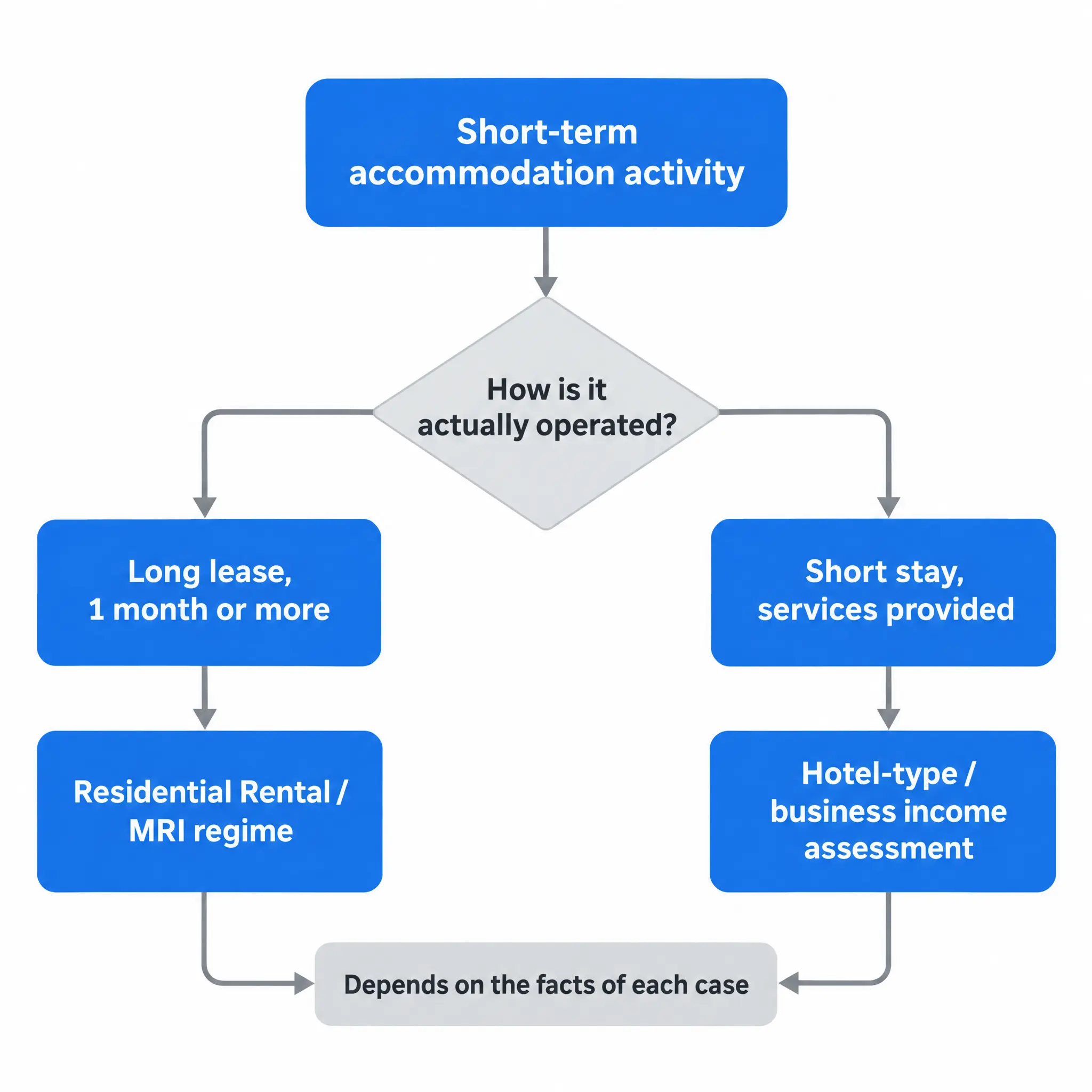
There is an important distinction between saying that an Airbnb is ‘a hotel’ for every tax purpose and saying that short-term accommodation can fall within the statutory concept of hotel accommodation for particular purposes.
Under the VAT Act, ‘residential premises’ do not include hotel or holiday accommodation. The Act also contains specific treatment for accommodation supplied in the hotel sector. This is why short-term accommodation should not automatically be treated in the same way as a conventional long-term residential lease.
TRA’s current licensing framework is also clear that serviced apartments and short-term rentals are regulated tourism enterprises. Its Class A licensing page specifically lists ‘Serviced Apartments/Short Term Rentals’ and also lists hotels, villas, service apartments, service flats, homestays and holiday cottages.
The practical conclusion is not that every Airbnb listing is automatically a hotel for every tax rule. It is that the host needs to determine the correct legal classification for each tax and regulatory obligation.
3. What Income Tax Do Airbnb Hosts Pay?
Where Airbnb activity is treated as business income rather than qualifying residential rental income, the taxable amount is generally based on the applicable income-tax rules for the taxpayer, with allowable business expenses considered subject to the law.
For an individual, KRA’s current individual income-tax bands rise progressively, with rates reaching 35% at the highest band. For a Kenyan resident company, the applicable corporation-tax rules generally apply to taxable profits.
Do not interpret this as meaning that every Airbnb host must automatically file under the ordinary business-income regime. The correct treatment depends on the facts and the applicable law. This is precisely why classification matters.
If the activity is within the residential rental regime, KRA’s MRI rules apply where the statutory conditions are met. MRI is 7.5% of gross residential rent and does not allow expenses, losses or capital deductions against the gross rent under that regime.
4. What Airbnb Expenses Can You Deduct?
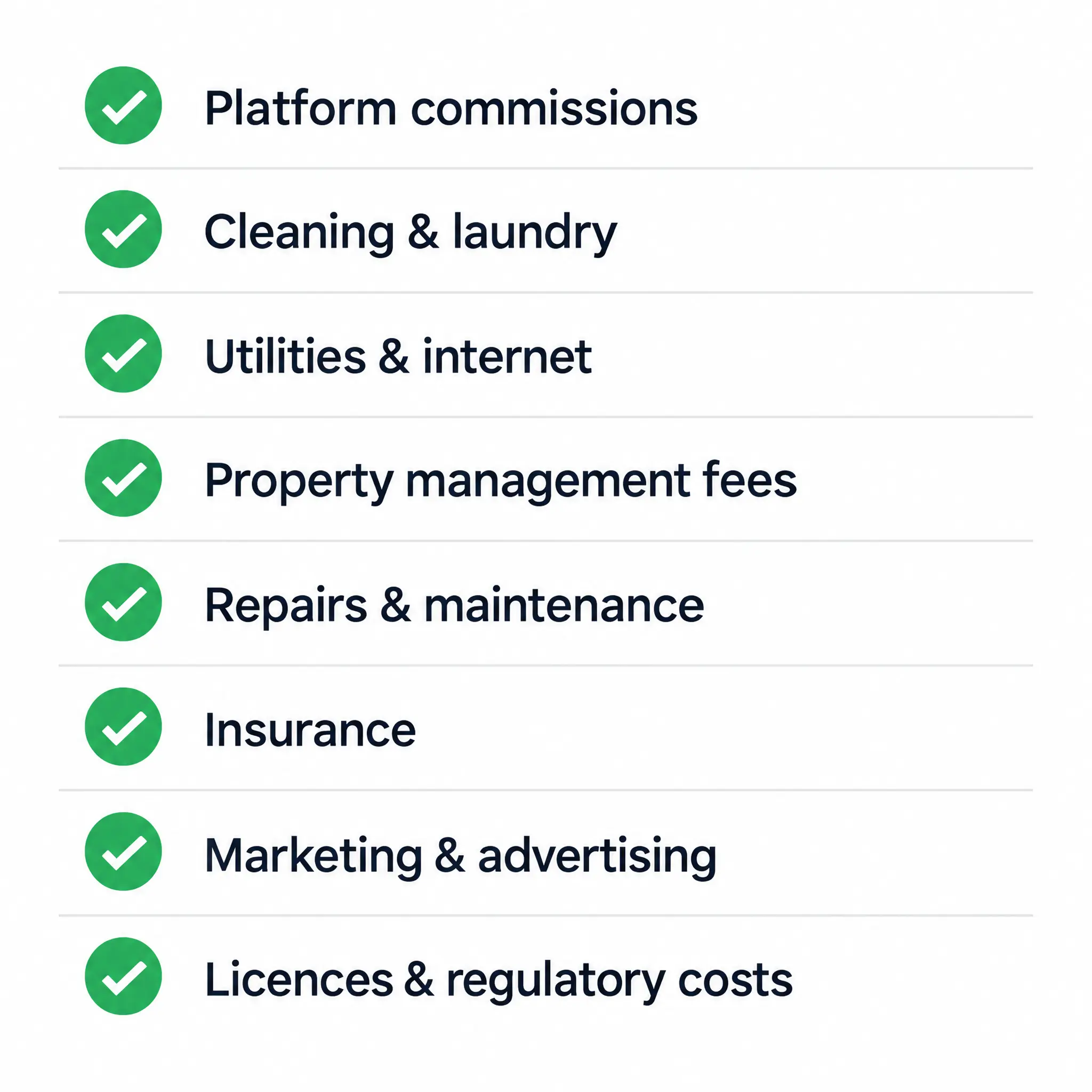
Where the applicable income-tax regime permits deductions, expenses should be genuinely incurred in producing the taxable income and supported by appropriate records.
- Airbnb or other platform commissions and fees
- Cleaning and laundry directly related to guest stays
- Electricity, water and internet used in the accommodation business
- Property management fees
- Repairs and maintenance
- Insurance where it relates to the income-producing activity
- Marketing and advertising
- Relevant licences and business-related regulatory costs
- Interest and other costs where specifically allowable under the applicable tax rules
Do not assume that every property expense is deductible. Keep invoices, receipts, statements and other evidence showing the connection between the expense and the income being declared. Where a property is used for both private and business purposes, apportionment may be required.
Looking for Airbnb Management in Nairobi?
Let Simpl handle your listing, guests, and day-to-day operations while you earn passively.
Tell us a bit about your property below and we'll be in touch to walk you through how we can take it over — no obligation.
We manage short-term rentals and long-term residential properties across Nairobi — Westlands, Karen, Runda, Ruaka, Kilimani and the CBD, among other areas.
Not sure if management is the right fit yet? Tick “Not sure yet” on the form and we'll help you figure out what makes sense for your property.
We'll only contact you about this enquiry and relevant property management opportunities.
5. Does Airbnb Pay VAT in Kenya?
Potentially, yes. The standard VAT rate is 16%, and the VAT registration threshold is generally KES 5 million in taxable turnover in a 12-month period, subject to the VAT Act and current KRA guidance.
The VAT analysis is important for short-term accommodation because the VAT Act distinguishes hotel or holiday accommodation from ordinary residential premises. A host whose taxable turnover reaches or is expected to reach the registration threshold should assess VAT registration and charging obligations rather than assuming that residential-rent VAT treatment applies.
If you are VAT registered, make sure your pricing and records clearly distinguish the accommodation value and VAT. Do not automatically assume that every amount a guest pays is tax-exclusive or tax-inclusive; the commercial terms and invoicing arrangement matter.
6. Does an Airbnb Host Need a TRA Licence?
Short-term accommodation can fall within the tourism activities regulated by the Tourism Regulatory Authority. TRA’s Class A licensing information expressly includes ‘Serviced Apartments/Short Term Rentals’ as well as hotels, villas, service apartments, service flats, homestays and holiday cottages.
The licence requirements depend on the category of the accommodation business. TRA’s current page lists different documentation requirements for serviced apartments/short-term rentals, villas, homestays and other categories.
The important point for an Airbnb host is that the obligation is linked to the regulated tourism activity, not simply to the fact that the booking came through Airbnb. A host should confirm the appropriate TRA category for the actual accommodation business.
TRA also provides an online licensing system through its TRIMS platform. Check the current requirements and fees before applying because licensing categories and administrative requirements can change.
7. What About the 2% Tourism Levy?
The Tourism Fund states that it collects a 2% tourism levy from regulated hotels, restaurants and regulated tourism activities in Kenya. Its current materials also provide guidance for serviced apartments.
However, the specific application of the levy to Airbnb and other short-term rental operators has been a developing regulatory issue in 2026. In September 2026, reporting on Tourism Fund’s 2025/26 results stated that regulations intended to enable collection from Airbnbs, homestays and villas had not been gazetted, contributing to a significant collection shortfall.
For that reason, this article does not tell every Airbnb host that they automatically owe a 2% levy on every booking. The safer position is to check the current regulations and Tourism Fund guidance applicable to your accommodation category at the time you operate and file.
If you are already registered with Tourism Fund or operate a regulated tourism establishment for which the levy is clearly applicable, follow the Fund’s current filing and payment requirements.
8. Does Airbnb Withhold Tax From Host Payouts?
Kenya’s tax rules contain withholding-tax provisions for payments made by the owner of a digital marketplace or platform. KRA’s published guidance following the Tax Laws Amendment Act, 2024, states that the withholding-tax rate for such payments is 5% for residents and 20% for non-residents, and that a PIN is not mandatory for the withholding transaction.
This is an important correction to the common explanation that says ‘Airbnb charges 5% if you have a PIN and 20% if you do not.’ The statutory distinction is based on the payee’s residency status, not simply whether a PIN has been entered.
For resident taxpayers, withholding tax is generally a credit rather than an additional final tax. Keep the withholding certificate and claim the credit when completing the relevant income-tax return. For non-residents, the tax treatment can be different and may be final where the statutory conditions are met.
9. What About Turnover Tax?
KRA currently states that TOT is charged at 1.5% of gross sales.
KRA says TOT applies to eligible resident persons or companies whose gross or expected turnover is more than KES 1 million but does not exceed KES 25 million in a year. KRA also states that rental income is excluded from TOT and that non-residents cannot use the regime.
This means an Airbnb operator should not automatically choose TOT simply because turnover is below KES 25 million. First determine whether the income is eligible for TOT at all and compare the regime with the applicable ordinary income-tax treatment.
TOT does not allow expenses to be deducted. It is charged on gross sales and is a final tax under the regime.
10. What Records Should an Airbnb Host Keep?
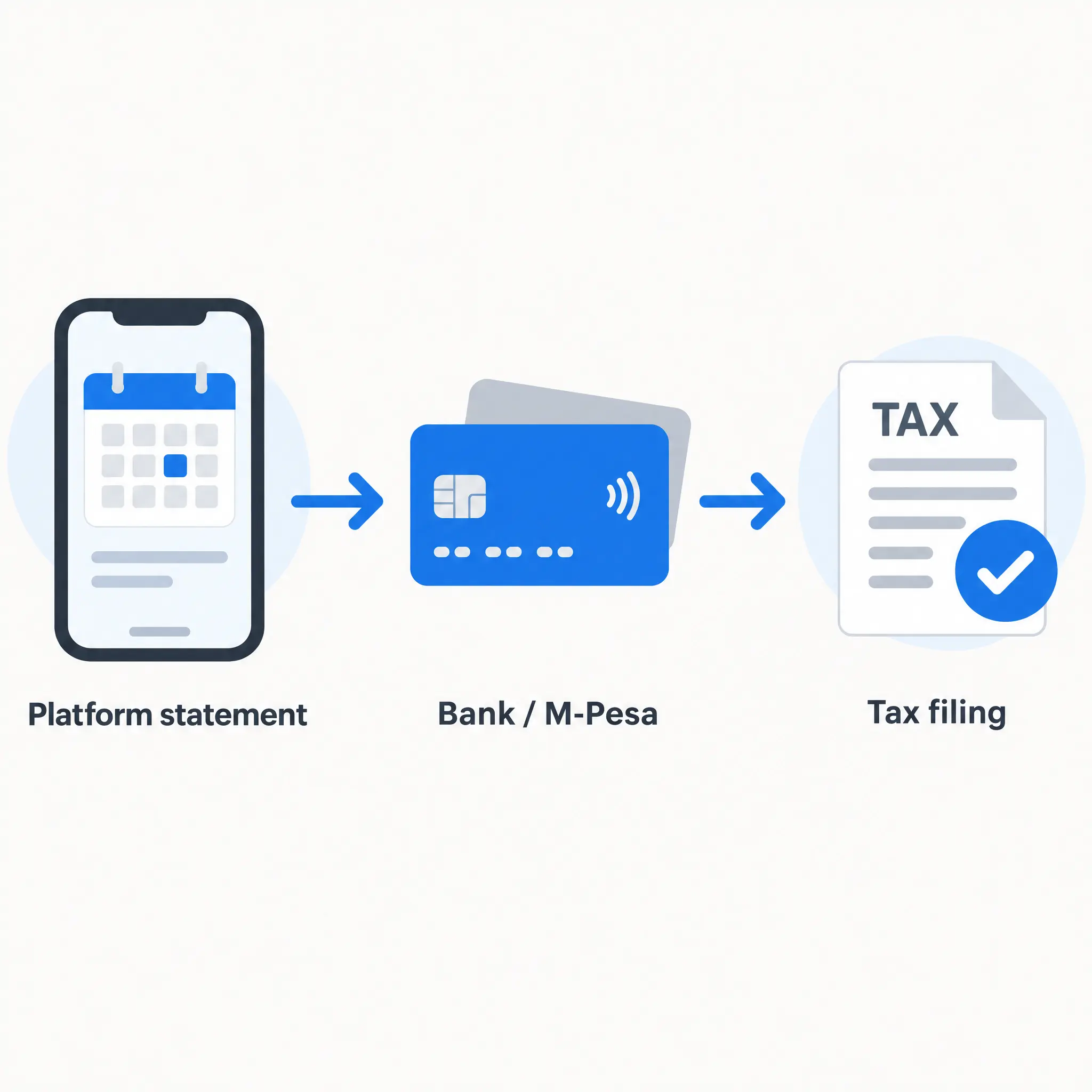
Good records are one of the most important parts of tax compliance. Keep documentation that allows you to reconcile bookings, platform statements, bank or mobile-money receipts, expenses and tax filings.
- Airbnb and other platform statements
- Booking and cancellation records
- Bank and M-Pesa statements
- Invoices and receipts for business expenses
- Cleaning, maintenance and utility records
- TRA licence and renewal documents
- VAT records where VAT registered
- Withholding-tax certificates
- Income-tax and other tax returns
- Contracts and management agreements
Where an expense is challenged, the ability to demonstrate what it was, why it was incurred and how it relates to the income can be as important as the amount itself. This kind of month-to-month reconciliation is exactly where professional property management earns its keep, since it’s the first thing an auditor checks and the easiest thing to let slip when you’re running a listing on the side.
11. What About Employees, Cleaners and Caretakers?
If you employ staff directly, separate payroll obligations can arise. Do not treat a cleaner or caretaker as an employee or independent contractor purely based on the label used in an agreement. The actual working arrangement matters.
Depending on the employment relationship, obligations can include PAYE, NSSF, the Social Health Insurance Fund contribution, Affordable Housing Levy and other statutory requirements. These rules change periodically, so payroll should be checked against current KRA and other government guidance.
12. A Simple Airbnb Tax Example
Suppose an individual operates a furnished apartment as a short-term accommodation business and receives KES 300,000 in booking revenue during a month.
- Gross booking revenue: KES 300,000
- Platform fees: KES 30,000
- Cleaning and laundry: KES 20,000
- Utilities and internet: KES 15,000
- Repairs and other directly related costs: KES 10,000
- Illustrative balance after these costs: KES 225,000
This is not a tax calculation. It simply illustrates why you should not apply a flat percentage to the booking revenue without first identifying the correct tax regime. If the applicable regime permits deductions, supported business expenses may affect taxable profit. If a final gross-based regime applies, those expenses may not reduce the tax.
VAT, withholding tax and any tourism levy should also be considered separately because they are not interchangeable with income tax.
13. Common Airbnb Tax Mistakes in Kenya
- Automatically declaring every short-term booking as ordinary residential rent without checking the applicable regime
- Assuming an Airbnb is legally a ‘hotel’ for every tax purpose
- Using the wrong Turnover Tax rate
- Treating withholding tax as an extra tax rather than considering the applicable credit/final-tax rules
- Assuming the tourism levy position is static despite regulatory changes
- Failing to assess VAT registration when taxable turnover approaches KES 5 million
- Claiming expenses without receipts or a clear business connection
- Mixing private and business property expenses without reasonable allocation
- Ignoring TRA licensing because the booking came through an online platform
- Failing to reconcile platform statements with bank and mobile-money records
Frequently Asked Questions
Is Airbnb income taxable in Kenya?
Yes. Income from short-term accommodation can be taxable in Kenya. The correct regime depends on the nature of the accommodation activity, taxpayer status and applicable tax law.
Is Airbnb taxed at 7.5% in Kenya?
Not automatically. KRA’s 7.5% MRI rate applies to qualifying residential rental income under the MRI regime. Short-term accommodation needs to be assessed separately because VAT and tourism regulations treat hotel/holiday accommodation differently from ordinary residential premises.
Do I need a TRA licence for one Airbnb unit?
Short-term accommodation is regulated by TRA, and TRA expressly lists serviced apartments/short-term rentals among its Class A enterprises. The appropriate category should be confirmed for the property and business model.
Does Airbnb attract the 2% tourism levy?
The Tourism Fund’s general levy framework is 2% for regulated tourism activities, but the specific extension of levy collection to Airbnb and other short-term rental operators was still subject to regulatory implementation in 2026. Check the latest Tourism Fund and gazetted regulatory position before filing.
What is the Airbnb withholding tax rate in Kenya?
KRA’s guidance for payments by the owner of a digital marketplace/platform states 5% for residents and 20% for non-residents. The distinction is based on residency, not simply whether a KRA PIN has been entered.
What is Turnover Tax in Kenya?
KRA currently states that Turnover Tax is 1.5% of gross sales for eligible resident businesses with turnover above KES 1 million and up to KES 25 million, subject to the exclusions and conditions in the law.
Do I pay VAT on Airbnb income?
VAT can apply to taxable accommodation supplies. The standard VAT rate is 16%, and registration is generally required once taxable turnover reaches or is expected to reach KES 5 million in a 12-month period.
Can I deduct Airbnb expenses?
That depends on the applicable income-tax regime. Where deductions are permitted, expenses should be genuinely incurred in producing taxable income and supported by proper records.
Should I register my Airbnb business as a company?
Not necessarily. The choice between operating as an individual, partnership or company has tax, legal, financing and administrative consequences. It should be made based on the owner’s circumstances rather than simply on the Airbnb platform. A qualified tax advisor or accountant can model this out against your actual numbers.
Where can I check the latest requirements?
Use KRA for tax rules and filing guidance, TRA for tourism licensing and Tourism Fund for tourism levy requirements. Because tax and tourism rules can change, check the current official position before filing, or confirm with a qualified tax and accounting professional.
What Airbnb Hosts Should Do Next
- Confirm how your accommodation activity is classified for each relevant tax and regulatory obligation.
- Check whether your turnover creates a VAT registration requirement.
- Confirm your TRA licence category and keep the licence current.
- Check the current Tourism Fund position on the 2% levy for your category.
- Reconcile Airbnb/platform statements with bank and mobile-money receipts.
- Keep evidence for every business expense you claim.
- Retain withholding certificates and use them correctly when filing.
- Get professional tax advice if you operate multiple properties, mix short-term and long-term letting, are non-resident, or have significant private use of the property. This matters even more if you’re managing a property from outside Kenya, where it’s harder to catch a missed deadline or licence renewal in time.
Official Sources & Further Reading
KRA – Individual Income Tax: https://www.kra.go.ke/individual/filing-paying/types-of-taxes/individual-income-tax/473-what-is-income-tax
KRA – Residential Rental Income Tax: https://www.kra.go.ke/individual/filing-paying/types-of-taxes/residential-rental-income
KRA – Turnover Tax: https://www.kra.go.ke/individual/filing-paying/types-of-taxes/turnover-tax-tot
KRA – Withholding Tax: https://www.kra.go.ke/individual/filing-paying/types-of-taxes/individual-withholding-tax
KRA – Finance Act 2026 changes: https://www.kra.go.ke/popular-links/finance-act-2026-what-it-means-for-you
Tourism Regulatory Authority – Class A licensing: https://tra.go.ke/licensing-2/tra-licensing-class-a/
Tourism Fund – Tourism Levy: https://www.tourismfund.go.ke/levy/
Kenya Law – Value Added Tax Act: https://new.kenyalaw.org/akn/ke/act/2013/35/eng@2024-04-26
Kenya Law – KB Cottages Nairobi Limited v Commissioner of Domestic Taxes: https://new.kenyalaw.org/akn/ke/judgment/ketat/2025/232/eng@2025-05-16
Official Sources & Further Reading
Kenya’s tax framework is changing. KRA’s Finance Act 2026 guidance states that most amendments took effect on 1 July 2026 and that new individual income-tax filing timelines take effect from 1 January 2027. Always confirm the current filing deadline and implementation guidance for the period you are filing.
This article is a general guide for informational purposes only. It is not tax, legal or accounting advice. Tax treatment depends on the specific facts of each property and taxpayer. Before making a filing or changing your tax position, consult a qualified Kenyan tax and accounting professional and check the latest legislation and official guidance.
About Simpl Property Management
Simpl Property Management helps property owners manage residential, commercial and short-term rental properties across Nairobi, including areas like Westlands, Karen, Runda and Ruaka. Our property management services include rent and income administration, maintenance coordination and short-term rental management, so the compliance side of running an Airbnb doesn’t fall entirely on you.
If you own an Airbnb or furnished apartment and would rather have the day-to-day operation, guest coordination, maintenance and property administration handled professionally, book a free property assessment with our team, or get in touch to talk through your setup. You can also find us on Google to see what current landlords say about working with us.