

PROPERTY MANAGEMENT IN KENYA (2026 GUIDE FOR LANDLORDS & INVESTORS)
TL;DR / Summary
- What is property management in Kenya? It’s when you hire a licensed professional to handle your rental property. They find tenants, collect rent, fix problems, and handle the daily work so you don’t have to.
- How much does property management cost? According to the Estate Agents Act, fees range from 2.5-10% of collected rent depending on property type. Most residential properties in Nairobi pay 7-10%.
- Is property management worth it? Yes for most landlords. Professional management typically reduces vacancy periods and improves rent collection, often paying for itself through better property performance.
- Who needs a property manager? Busy professionals, diaspora property owners, investors with multiple properties, and landlords facing high vacancies or tenant problems.
Why Property Management Matters in Kenya
Let me tell you what usually happens.
You buy a rental property in Nairobi. Maybe it’s an apartment block in Kilimani or a house in Westlands. You think managing it yourself will save money. Then reality hits.
Your tenant calls at midnight because the fuse box tripped. Another tenant is three months behind on rent and you don’t know how to handle it legally. The property sits empty for five months because you can’t find good renters. You spend every weekend dealing with complaints instead of focusing on your business or family.
This is where property management in Kenya comes in.
Property management is important because:
- It protects your rental income. Professional managers reduce vacancy periods and improve rent collection rates.
- It preserves your property value. Regular maintenance prevents small problems from becoming expensive repairs.
- It ensures legal compliance. Property managers understand the the various laws and regulations, protecting you from legal issues.
- It saves your time. Most landlords save 15-20 hours monthly after hiring property management services.
- It provides peace of mind. No more emergency calls, no more chasing rent, no more weekend disturbances.
I’ve managed properties across Nairobi for over 15 years. I’ve seen what works and what doesn’t. This guide shares real advice based on hundreds of properties and thousands of tenant interactions.
What is Property Management in Kenya?
Property management in Kenya means hiring someone to run your rental property like a business. They handle everything you normally do as a landlord, but professionally and legally.
Think of it like this: You own a matatu. You could drive it yourself every day. Or you could hire a driver and conductor to run it while you focus on buying more matatus. That’s what property managers do for your real estate.
According to the Estate Agents Act (Chapter 533), property management includes bringing together landlords and tenants, negotiating lease terms, and managing properties on behalf of owners. All property managers in Kenya must be registered with the Estate Agents Registration Board (EARB).
What Do Property Management Companies Do?
Property management companies in Kenya play a vital role in helping property owners maximize returns while minimizing stress. Professional property managers in Kenya take care of everything from tenant relations to property maintenance, ensuring your investment is safe, compliant, and profitable.
Roles and Responsibilities of a Property Manager in Kenya
A property manager in Kenya handles both operational and financial aspects of your property. Key responsibilities include:
Rent Collection: Ensuring tenants pay on time and managing overdue payments efficiently.
Tenant Screening: Carefully vetting prospective tenants to ensure reliability and suitability.
Maintenance Management: Coordinating repairs, preventive maintenance, and addressing tenant requests promptly.
Legal Compliance: Making sure your property follows local regulations, tenancy laws, and safety standards.
Service Charge Management: Overseeing common area expenses with transparency and fairness. Learn more about our service charge management services.
Financial Reporting: Providing detailed statements, cash flow reports, and expense tracking to keep owners informed.
Vacancy Management: Marketing vacant units, managing showings, and minimizing empty periods to maximize rental income.
Simpl’s property managers in Kenya are available 7 days a week to handle tenant issues, maintenance requests, and owner reporting. Whether you own residential, commercial, or retail property, our team ensures a hassle-free experience for both owners and tenants.
By working with a professional property management company, you gain access to expert property management services, peace of mind, and improved property profitability. Check out our residential property management services and retail property management services to see how we can help.
Managing tenants, rent, and repairs can get stressful fast.
If you want professional help running your property in Kenya, request a free consultation here.
Phone: +254 768 855005
Email: info@simplproperties.co.ke
The Responsibilities of a Property Manager in Kenya
Here’s exactly what property managers do:
1. Finding and Screening Tenants
This is the most important job. Good tenants pay on time and take care of your property. Bad tenants cause endless problems.
What they do:
- Advertise your property on multiple platforms (Facebook, BuyRentKenya, property websites)
- Show the property to interested people
- Check ID documents, employment details, and previous landlord references
- Verify income to ensure tenants can afford the rent
Prepare and sign legal lease agreements
2. Collecting Rent
No more chasing tenants for money. Property managers handle all rent collection.
What they do:
- Set up payment methods (M-Pesa, bank transfer, direct deposit)
- Send payment reminders before rent is due
- Follow up on late payments professionally
- Handle payment plans for tenants with temporary difficulties
- Start legal eviction processes when necessary
- Send you your money on time every month
3. Maintenance and Repairs
No more emergency calls at 2 AM. Property managers coordinate all repairs.
What they do:
- Handle tenant maintenance requests
- Coordinate with plumbers, electricians, and other contractors
- Get your approval for major repairs (usually anything over KES 10,000-20,000)
- Schedule preventive maintenance to avoid bigger problems
- Keep records of all maintenance work
4. Property Inspections
Regular inspections catch problems early.
What they do:
- Quarterly property checks (every 3 months)
- Move-in inspections with photos
- Move-out inspections to assess any damage
- Safety checks (smoke detectors, security, electrical)
5. Handling Tenant Issues
Tenants call the property manager, not you.
What they do:
- Answer tenant questions and complaints
- Mediate disputes between tenants
- Enforce lease rules and regulations
- Handle lease renewals
6. Financial Reporting
You get clear reports every month showing exactly where your money went.
What they do:
- Monthly financial statements
- Track all income and expenses
- Provide receipts for all paid bills
Help with tax documentation
7. Legal Compliance
Property management in Kenya requires understanding the various laws and regulations.
What they do:
- Ensure lease agreements follow Kenyan law
- Handle security deposits legally
- Follow proper eviction procedures
- Maintain EARB compliance
8. Service Charge Management (For Multi-Unit Properties)
For apartment blocks and gated communities, property managers handle shared costs.
What they do:
- Collect monthly service charges from all units
- Pay for security guards
- Handle water and electricity bills for common areas
- Coordinate garbage collection
- Maintain shared facilities (gates, gardens, parking)
Types of Property Management in Kenya
Different property types need different management approaches.
This is for rental homes and apartments.
What they manage:
- Single houses (like in Karen, Runda, Lavington)
- Apartment buildings (Kilimani, Kileleshwa, Westlands)
- Bedsitters and studios
- Townhouses and gated communities
- Short-term rentals (Airbnb)
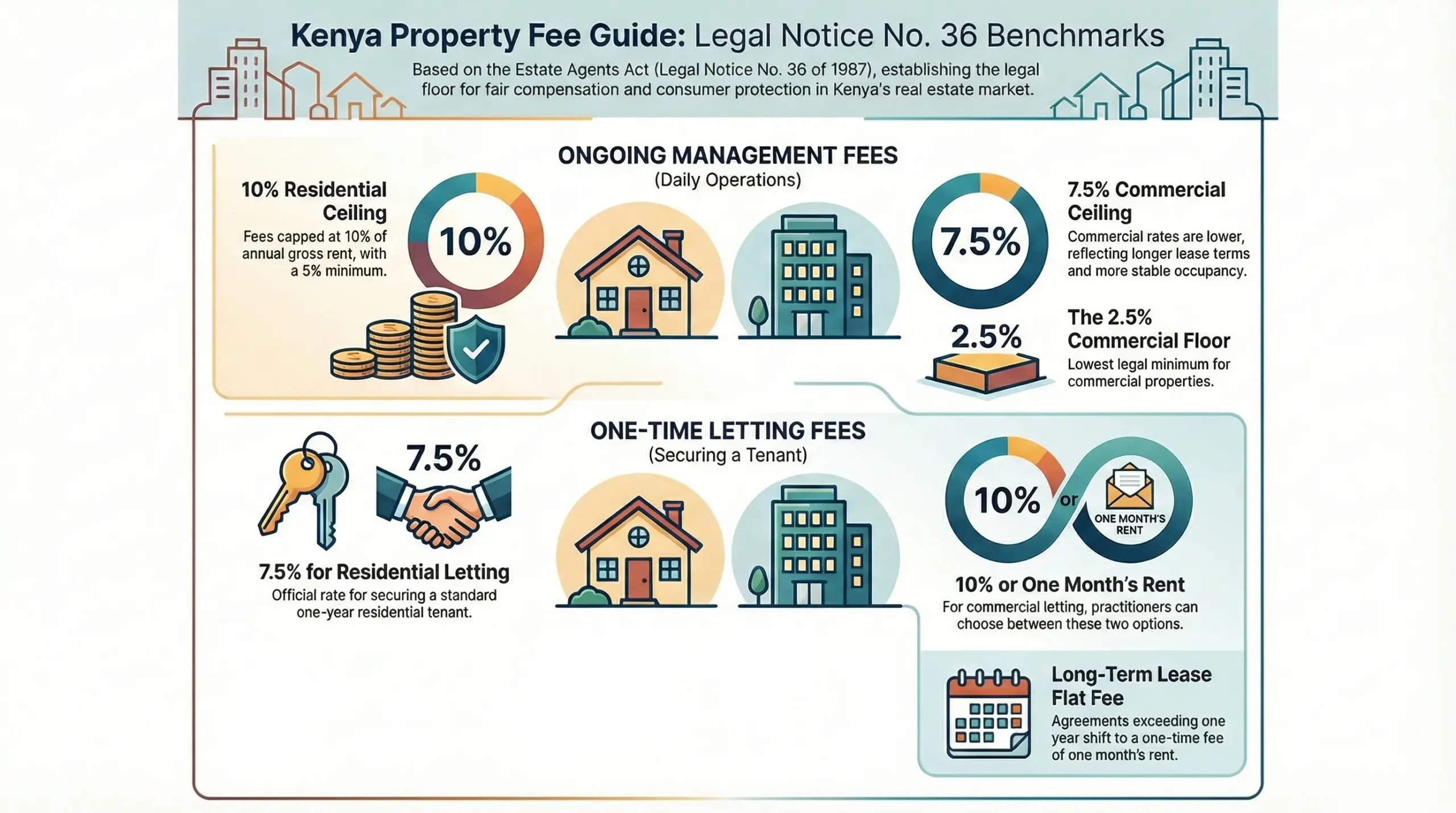
Estate Agents Act Fee: 10% of gross annual rent (can be negotiated to minimum 5%)
What residential managers handle:
- tenant screening
- lease signing
- rent reminders
- repairs coordination
- caretaker supervision
- move-in inspections
- deposit handling
This is especially useful if:
- you live abroad
- you have multiple units
- you inherited property
- you don’t want tenant phone calls
This is for business properties.
What they manage:
- Office buildings (Westlands, Upper Hill, CBD)
- Retail spaces and shops
- Warehouses and industrial facilities
- Co-working spaces
- Hotels
Estate Agents Act Fee: 7.5% of gross annual rent (can be negotiated to minimum 2.5%)
Commercial managers focus on:
- lease negotiations
- tenant mix strategy
- service charge budgets
- security coordination
- maintenance contracts
- occupancy planning
Shopping centers and malls need special attention.
What they manage:
- Shopping malls
- Strip malls and retail centers
- Market stalls
Extra services include managing common areas, coordinating promotions, and handling multiple tenants at once.
Retail centres in growing areas like:
- Ngong Road
- Karen
- Eastlands
- Mombasa Road
often need professional retail managers.
Industrial Property Management
Industrial properties have unique needs.
What they manage:
- Manufacturing facilities
- Warehouses and distribution centers
- Industrial parks
- Data centers
Special Purpose Property Management
Some properties don’t fit normal categories but still need professional management.
What they manage:
- Workplace and facilities management
- Theaters and entertainment venues
- Sports arenas
- Resorts and vacation properties
- Senior care facilities
- Schools and universities
- Places of worship
These properties require specialized knowledge and management approaches beyond typical residential or commercial property management.
Property Management Costs in Kenya (Official & Actual Rates)
Let me show you the official fees from the Estate Agents Act and what you’ll actually pay in Nairobi.
Estate Agents Act Fee Structure (Legal Notice No. 36 of 1987)
These are the official regulated fees under Kenyan law:
What You'll Actually Pay in Nairobi (2025)
Most property management companies charge monthly fees. Here’s what’s common:
|
Property Type |
Monthly Fee |
Example Rent |
Monthly Cost |
|
Bedsitter/Studio |
10% of rent |
KES 15,000 |
KES 1,500 |
|
2-Bedroom Apt |
8% of rent |
KES 50,000 |
KES 4,000 |
|
3-Bedroom House |
7% of rent |
KES 100,000 |
KES 7,000 |
|
Commercial Office |
5% of rent |
KES 800,000 |
KES 48,000 |
|
Retail Space |
3% of rent |
KES 1,500,000 |
KES 45,000 |
Note: All fees subject to 16% VAT under Kenyan tax law and the above figure are for illustration purposes only. Additional fees may include tenant placement (50-100% of first month’s rent) and setup fees (KES 5,000-15,000).
From Struggle to Success - Real Example:
12-Unit Apartment Block in Kilimani
Let me share a real story from one of our clients. Names changed, but the numbers are accurate.
The Situation Before Simpl Property Management
Mr. K. Opondi owns a 12-unit apartment block in Kilimani. Each unit rents for KES 45,000 monthly. He was managing it himself with help from a caretaker.
The Problems:
- High vacancy: Average 3 units empty at any time (25% vacancy rate)
- Late payments: Only collecting 80% of rent on time, chasing people constantly
- Maintenance problems: Emergency repairs costing KES 85,000 some months because small issues weren’t caught
- Time drain: Spending 25-30 hours monthly on property issues
- No systems: Poor record keeping, missing receipts, tax nightmares
The Numbers (Before):
Potential monthly income: KES 540,000 (12 units × 45,000)
Actual monthly income: KES 324,000 (9 units × 45,000 × 80% collection)
Annual income: KES 3,888,000
What We Did
Mr. K. Opondi hired us for property management in January 2024. Here’s what we implemented:
- Deep-cleaned all vacant units and fixed minor issues
- Advertised on 5 platforms simultaneously
- Screened all new tenants properly (ID check, employment verification, reference calls)
- Set up automatic M-Pesa rent collection with reminders
- Started quarterly inspections of all units
- Created maintenance schedule for preventive work
- Negotiated better rates with contractors (plumber, electrician, painter)
- Implemented proper bookkeeping with monthly reports
Results After 12 Months
Occupancy:
- Filled all 12 units within 6 weeks
- Maintained 100% occupancy for 9 of the 12 months
- Average vacancy dropped to 8% (from 25%)
Rent Collection:
- Collection rate improved to 97%
- Only one eviction needed (handled legally and properly)
Maintenance:
- Emergency repairs dropped by 70%
- Average monthly maintenance: KES 25,000 (down from 85,000)
- Annual maintenance savings: KES 720,000
The Final Numbers:
Monthly income (with 8% vacancy, 97% collection): KES 492,372
Annual income: KES 5,908,464
Management fees (8%): KES 39,398/month = KES 472,776/year
Net income after management fees: KES 5,435,688
Improvement over previous year: KES 1,547,688 (40% increase)
Even after paying management fees, Mr. K. Opondi earned KES 1.5 million more. Plus he got back 25-30 hours monthly to focus on his business.
Who Benefits from Property Management in Kenya?
Property management isn’t for everyone. Here’s who benefits most:
- Busy Professionals and Business Owners
If you’re running a business or have a demanding career, property management saves you 15-20 hours monthly. That’s time you can spend earning more or with family. - Diaspora Property Owners
Managing property from Dubai, UK, USA, or anywhere abroad is nearly impossible. You need someone on the ground handling emergencies and watching your investment. - Investors with Multiple Properties
Once you have 3+ properties, self-management becomes overwhelming. Professional property management provides scalable systems. - First-Time Landlords
New to rental property? The learning curve is steep. Property managers help you avoid expensive mistakes while you learn. - Landlords Facing Problems
If you’re experiencing:
• High vacancy rates (more than 2 months annually)
• Difficult tenants or frequent disputes
• Late rent payments or collection struggles
• Property deterioration from deferred maintenance
Professional property management in Kenya can turn these situations around.
Frequently Asked Questions About Property Management in Kenya
These are real questions from landlords in Nairobi. I’m answering them based on years of experience managing properties in Kenya.
How much does property management cost in Kenya?
Property management in Kenya costs 5-10% of monthly rent for residential properties and 2.5-7.5% for commercial properties according to the Estate Agents Act. Most companies in Nairobi charge 7-10% for apartments and houses. For a KES 50,000 apartment, expect to pay KES 4,000 monthly.
What do I do if my tenant doesn't pay rent in Kenya?
Here’s the process property managers follow:
- Week 1: Send friendly reminder via SMS and WhatsApp
- Week 2: Personal call to understand the problem, offer payment plan if needed
- Week 3: Formal written notice (keep copy for legal purposes)
- Month 2: Start legal eviction through lawyer (takes 2-3 months in Nairobi)
Good tenant screening prevents 80% of payment problems. That’s why professional property managers spend time on background checks.
How do I find good tenants in Nairobi?
Follow these steps:
- Price it right: Research similar properties in your area
- Make it attractive: Fresh paint and good photos rent 50% faster
- Advertise widely: Facebook groups, BuyRentKenya, WhatsApp
- Screen thoroughly: Check ID, call employer, talk to previous landlord
- Move fast: Good tenants in Westlands get snapped up in 2-3 days
Property management companies in Kenya typically fill vacancies in 3-4 weeks because they do this professionally every day.
Is property management worth it in Kenya?
Yes, for most landlords. Here’s the math:
If management fees are 8% and they reduce your vacancy from 20% to 10%, you’re already ahead. Add better rent collection (going from 85% to 97%) and lower maintenance costs, and most landlords see 10-25% income improvement.
Plus you save 15-20 hours monthly. Can you put a price on your weekends?
Who is the best property management company in Nairobi?
Most people ask, “who is the best property management company near me?” for you depends on your needs and location. Look for:
- EARB licensing: This is mandatory. Verify at estateagentsboard.or.ke
- Local experience: Do they manage properties in your specific area?
- Real references: Talk to their current clients
- Transparent fees: Everything should be clear in writing
- Modern systems: Online payments, digital reporting
We manage properties across Nairobi and are EARB licensed. Call +254 768 855005 or email info@simplproperties.co.ke for a free consultation.
How long does it take to find a tenant in Nairobi?
With professional property management: 3-4 weeks on average in 2025.
It depends on:
- Location: Westlands and Kilimani fill faster than Runda
- Price: Overpriced properties sit for months
- Condition: Fresh paint makes a big difference
Season: January-March is busy, December is slow
Do property managers handle evictions in Kenya?
Yes. Professional property managers handle the entire eviction process legally:
- Try to resolve the issue (payment plans, etc.)
- Send formal legal notices
- File court case if necessary
- Coordinate with lawyers and courts
Legal evictions in Nairobi take 2-3 months. Good tenant screening prevents most of these situations
Can I manage property in Kenya from abroad?
Yes, but only with professional property management. Managing from Dubai, UK, USA, or anywhere abroad without a property manager is nearly impossible.
You need someone on the ground to:
- Handle emergencies (burst pipes at 2 AM)
- Show property to prospective tenants
- Coordinate repairs with contractors
- Handle tenant issues in person
- Conduct property inspections
We manage properties for o diaspora owners across 8 countries. Monthly reports and online payments make it easy.
Areas we commonly manage property in Kenya
Professional property managers typically cover:
- Westlands
- Kilimani
- Kileleshwa
- Karen
- Parklands
- Lavington
- South B / South C
- Ruaka
- Athi River
- Thika Road corridor
- Nairobi Central Buisness District (CBD)
Local knowledge matters.
Each area has different tenant types and rental trends.
Are property managers regulated in Kenya?
Yes. All property managers in Kenya must be registered with the Estate Agents Registration Board (EARB) under the Estate Agents Act, Chapter 533.
Licensed property managers must:
- Meet professional qualifications
- Follow ethical guidelines
- Carry proper insurance
- Follow regulated fee structures
IMPORTANT: Always verify EARB registration at estateagentsboard.or.ke before hiring any property manager. Unlicensed operators cause legal problems.
Get Started with Professional Property Management
Property management in Kenya makes owning rental property easier and more profitable.
Remember:
- Management fees (7-10%) typically pay for themselves through better operations
- Professional management reduces vacancy by 50-70%
- You save 15-20 hours monthly
- Most clients see 10-25% income improvement
About Simpl Property Management
We’re a fully EARB-licensed property management company serving Nairobi and surrounding areas since 2015.
Our services:
Contact us:
- Phone: +254 768 855005
- Email: info@simplproperties.co.ke
We offer free property assessments and transparent pricing. No long-term lock-ins. Call today.