NSSF Twin Towers Nairobi: The Complete Guide to Kenya's Most Ambitious Building
TL;DR / Summary
NSSF is building two towers at the junction of Kenyatta Avenue and Uhuru Highway in Nairobi’s CBD. Tower A stands 260 metres tall across 60 floors, the tallest building in East and Central Africa. The Ksh 30 billion development includes premium offices, a business hotel, serviced apartments, retail, conference facilities, and an observation deck on the 56th floor. Construction begins once regulatory approvals are finalised. This page is updated as the project progresses.
If you’ve walked past the corner of Kenyatta Avenue and Uhuru Highway recently, you’ve walked past a dusty car park. It doesn’t look like much. But Plot Block 78/750, owned by the National Social Security Fund, is about to become the most significant piece of real estate in East Africa.
I’ve spent time going through the Environmental Impact Assessment, the Expression of Interest documents, and NSSF’s corporate strategy papers for this project. I’ve also been to the site. This is the most complete guide to the NSSF Twin Towers project you’ll find: what’s being built, who’s building it, what it means for Nairobi, and what it’s actually going to take to manage a building of this scale once it opens.
This page is updated regularly as the project moves from approvals to groundbreaking to construction milestones and handover. Bookmark it.
What Is the NSSF Twin Towers Project?
Quick Answer
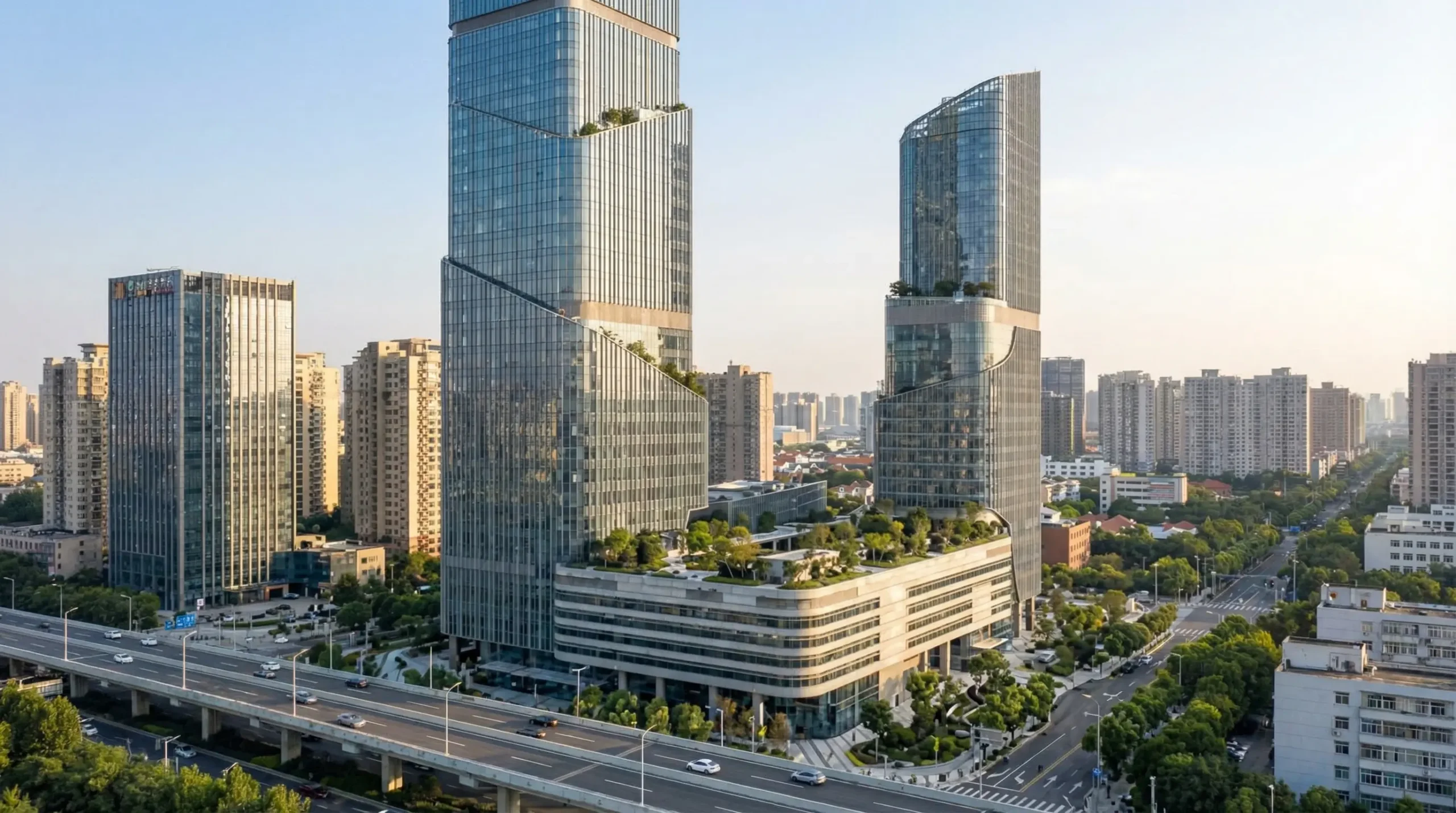
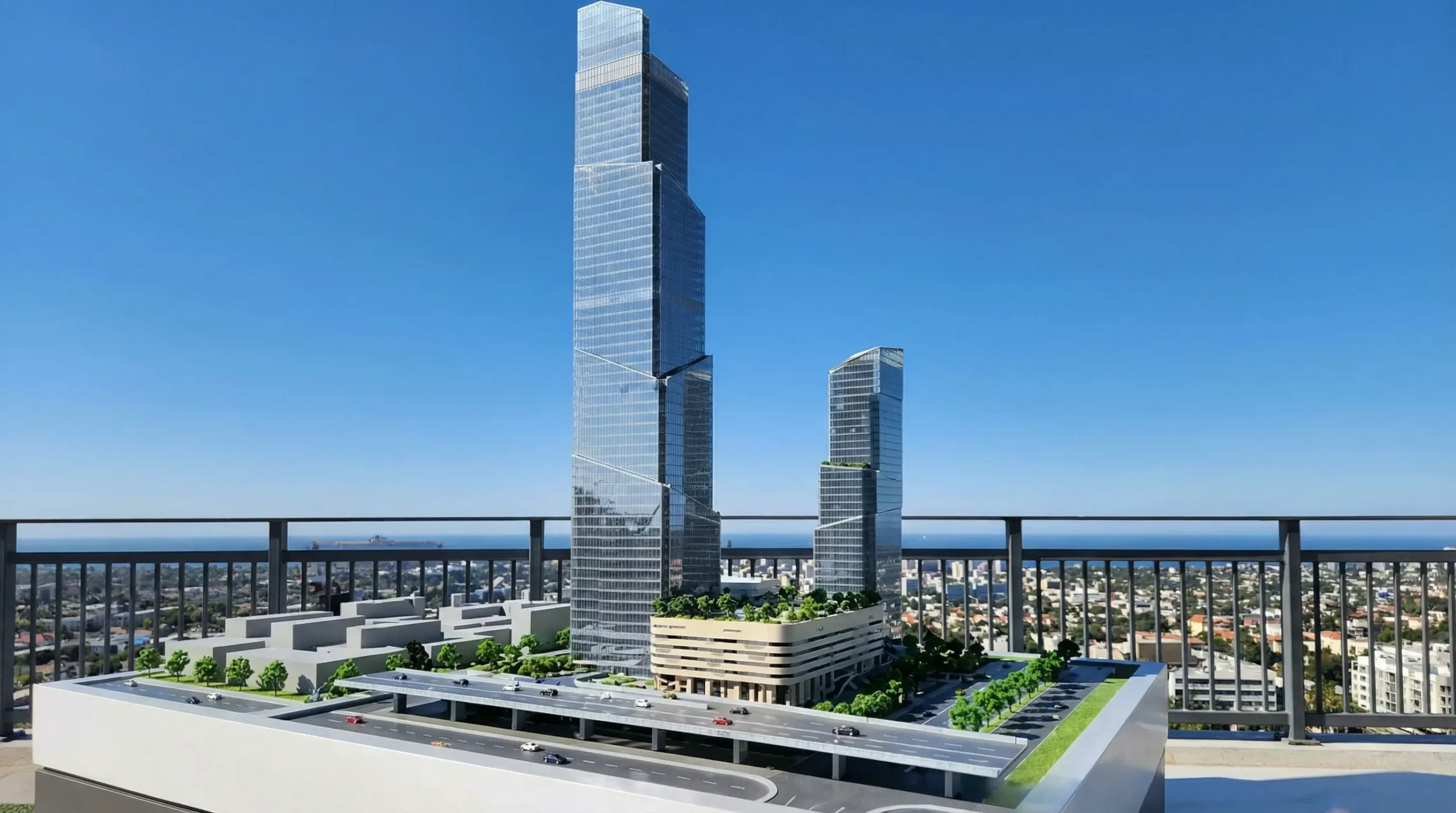
The NSSF Twin Towers is a Ksh 30 billion mixed-use development at the corner of Kenyatta Avenue and Uhuru Highway in Nairobi's CBD. It comprises two towers, Tower A at 260 metres and 60 floors, and Tower B at 140 metres and 35 floors, connected by a shared 42.4-metre podium. The total built-up area is 164,495 m2. Once complete, Tower A will be the tallest building in East and Central Africa.
The development brings together a genuinely international project team. The developer is the National Social Security Fund (NSSF). The contractor is the China Road and Bridge Corporation (CRBC), part of the CCCC Third Highway Engineering Co. Ltd Consortium. The building was designed by the China Academy of Building Research (CABR), with Surbana Jurong of Singapore serving as design advisor. The Kenyan members of the team are Architect Engineer Francis Ikere of Shelter Solutions Ltd and Structural Engineer Eng. Wilson Wamahiu Munene.
Architecturally, the design draws inspiration from Kenya’s Great Rift Valley. The tower’s layered, stratified facade mimics the geological fissures of the valley walls, staggered terraces that recede progressively like rock formations. Viewed from the street, the seams create a dynamic interplay of intersecting planes. It is not a generic glass box.
What Will Each Tower House?
Based on the official site board and Environmental Impact Assessment, here is the breakdown per tower. Note that the full use-per-floor allocation has not yet been publicly confirmed. This section will be updated when detailed floor plans are released.
Tower A — The Tall One (260 Metres, 60 Floors)
Tower A has 3 basement levels, a ground floor, 55 standard floors, and a 56th floor dedicated entirely to an observation deck. This is the prestige tower. It rises to 260 metres, putting it in the same global conversation as One Canada Square in London’s Canary Wharf (235 metres).
The upper floors of Tower A are designed for premium office space. The observation deck on the 56th floor will offer panoramic views across Nairobi, including Nairobi National Park, the Ngong Hills, and the full sweep of the city skyline.
Tower B — The Shorter Tower (140 Metres, 35 Floors)
Tower B has 2 basement levels, a ground floor, 31 standard floors, and a roof floor. At 140 metres, it is equivalent in height to Kenya’s current tallest building, Times Tower. Tower B is designed to house the business hotel and serviced residential apartments.
The Podium (42.4 Metres, 7 Floors)
The podium is the shared base that connects both towers. It rises 42.4 metres across 7 floors above ground, with 1 basement level. This is where retail outlets, conference facilities, and the main arrival experience sit. The basement and podium levels also house parking for approximately 1,150 vehicles, one of the largest dedicated parking facilities in Nairobi’s CBD.
The Story Behind the Site
This land has been NSSF’s since the 1960s. For decades it sat largely idle, used as a temporary car park while the land appreciated and various interests circled it.
The site has not been without drama. In 2025, the Directorate of Criminal Investigations (DCI) arrested three individuals for allegedly attempting to fraudulently transfer the title using falsified documents. The case underlines just how valuable this land is, and why NSSF’s decision to finally develop it is significant.
So why now? The answer is the revised NSSF Act. Worker contributions, which had been capped at a nominal Ksh 200 per month, were revised dramatically under the NSSF Act 2013. Workers now contribute up to Ksh 6,480 per month. As NSSF Managing Trustee David Koross confirmed publicly, the Ksh 30 billion project will be fully funded by the pension fund over four years, riding on the significantly increased contributions now flowing in.
NSSF’s fund value stood at Ksh 400 billion as of August 2024, with over one million members. This building is being built with workers’ pension contributions. That context matters. NSSF has set a minimum target return of 12% on the investment.
How Do You Build the Tallest Building in East Africa?
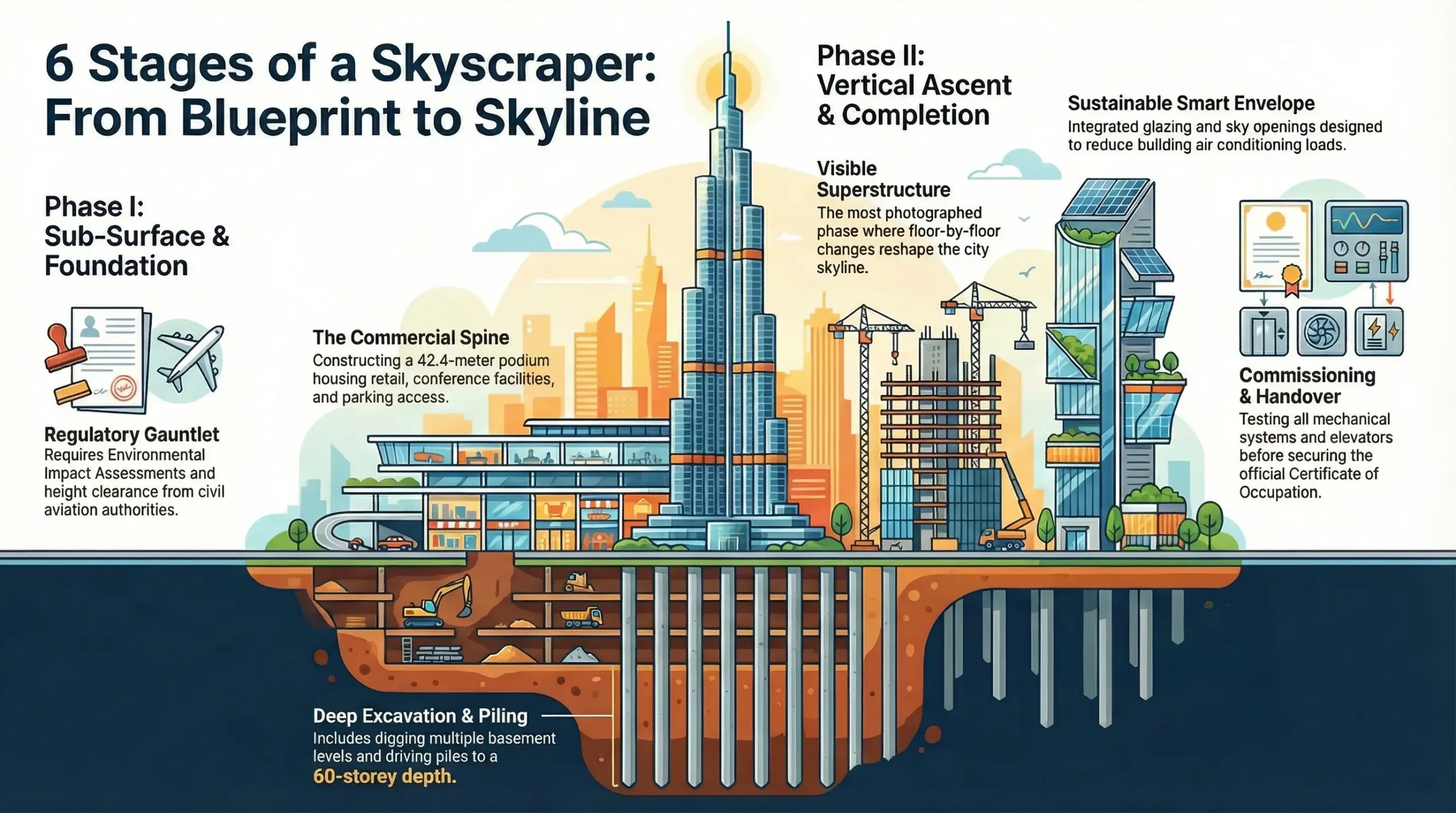
Building a 260-metre tower in the middle of a functioning city is not a small undertaking. Here is how it happens, stage by stage, in plain language
Stage 1 — Regulatory Approvals (Currently Underway)
Before a single shovel goes in the ground, NSSF needs sign-off from multiple authorities. The Environmental Impact Assessment was submitted to NEMA in November 2025. The public comment period is open. The project also needs height clearance from the Kenya Civil Aviation Authority (KCAA), at 260 metres, this is mandatory under the Civil Aviation Act. County building permits must also be secured before construction begins.
Stage 2 — Site Preparation and Excavation
The car park goes. Excavation then begins, digging three basement levels for Tower A and two for Tower B, all in the middle of the Nairobi CBD. The site has four vehicular entrances. The EIA requires a full Traffic Management Plan to keep Kenyatta Avenue moving during this phase.
Stage 3 — Foundation and Structural Core
Foundation piling at 60-storey depth. Then the structural core goes up, reinforced concrete and structural steel including cutting, welding, and erection. This is the most noise-intensive phase of the build. The EIA requires sound barriers for pile driving and restricted working hours in line with NEMA licensing conditions.
Stage 4 — The Podium
While the tower cores rise, the podium is built at the base. This 42.4-metre structure is where retail, conference, and parking access will live. It does not look dramatic from the street at this stage — but this is where the building’s commercial spine gets built.
Stage 5 — Superstructure Rise
Both towers climb simultaneously. This is the visible stage, the one Nairobi will follow on social media. Floor by floor, the skyline changes. This phase will take the longest and will be the most photographed.
Stage 6 — Building Envelope
The Rift Valley-inspired facade goes on. Glazing, layered terracing, and the mid-section sky opening that allows natural cross-ventilation through the building. This design feature is not decorative, it actively reduces air conditioning load.
Stage 7 — MEP Fit-Out
Mechanical, electrical, and plumbing systems are installed across 164,495 m2. This includes solar PV panels, rainwater harvesting plumbing, CCTV and security systems, Kenya Power connection, and water reticulation from Nairobi City Water and Sewerage Company.
Stage 8 — Interior Fit-Out
Office floors, hotel rooms, residential apartments, and retail units are fitted out. Each has different specifications, finishes, and compliance requirements. This stage runs in parallel for different sections of the building.
Stage 9 — Pre-Commissioning and Testing
Every system is tested before a tenant steps foot in the building. Lifts, fire suppression, solar PV, the Building Management System (BMS), and generators. This is the stage where the facilities management partner should already be embedded, not waiting for the keys.
Stage 10 — Certificate of Occupation and Handover
Once the county authority issues the Certificate of Occupation, the building goes live. This is the finish line for the contractor. It is the starting line for the property manager.
NSSF Twin Towers Construction Progress
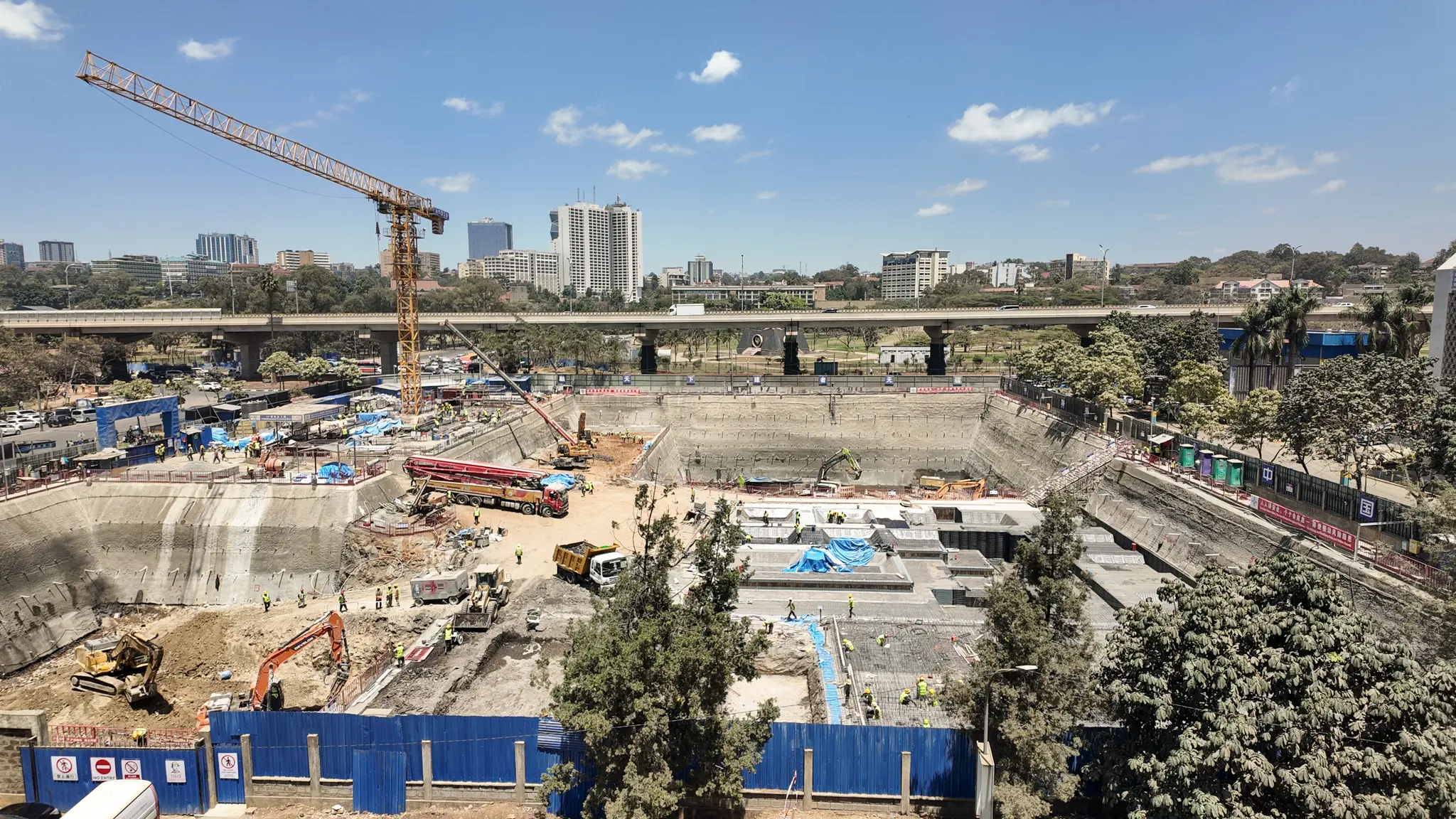
Current stage: Foundation and Substructure Works
Construction of the NSSF Twin Towers has progressed significantly since the project broke ground earlier in 2026. As of August 2026, the site has moved beyond the major excavation phase and is now focused on the foundations and underground structural works.
Interested in Space at NSSF Twin Towers?
The towers are still under construction and no leasing information has been released publicly. When it is, the people on this list hear first.
Register below and we'll notify you as soon as verified details are available — floor plates, unit sizes, service charge, rent guidance and how to apply.
Simpl Property Management is not the appointed letting agent for NSSF Twin Towers. We track the development professionally and share information as it is confirmed.
Need space sooner? We let and manage Grade A office space in Westlands right now — tick “Office space” above and we’ll send you what’s available.
We’ll only contact you about NSSF Twin Towers and relevant property opportunities.
Follow the NSSF Twin Towers as they rise.
We track each construction stage, tenant opportunities and what the project means for Nairobi CBD property. Add Simpl as a preferred source on Google and our updates are more likely to show up in your Top Stories.
Takes 10 seconds. You can remove us anytime.
How Does 260 Metres Compare? Putting the NSSF Twin Towers in Context
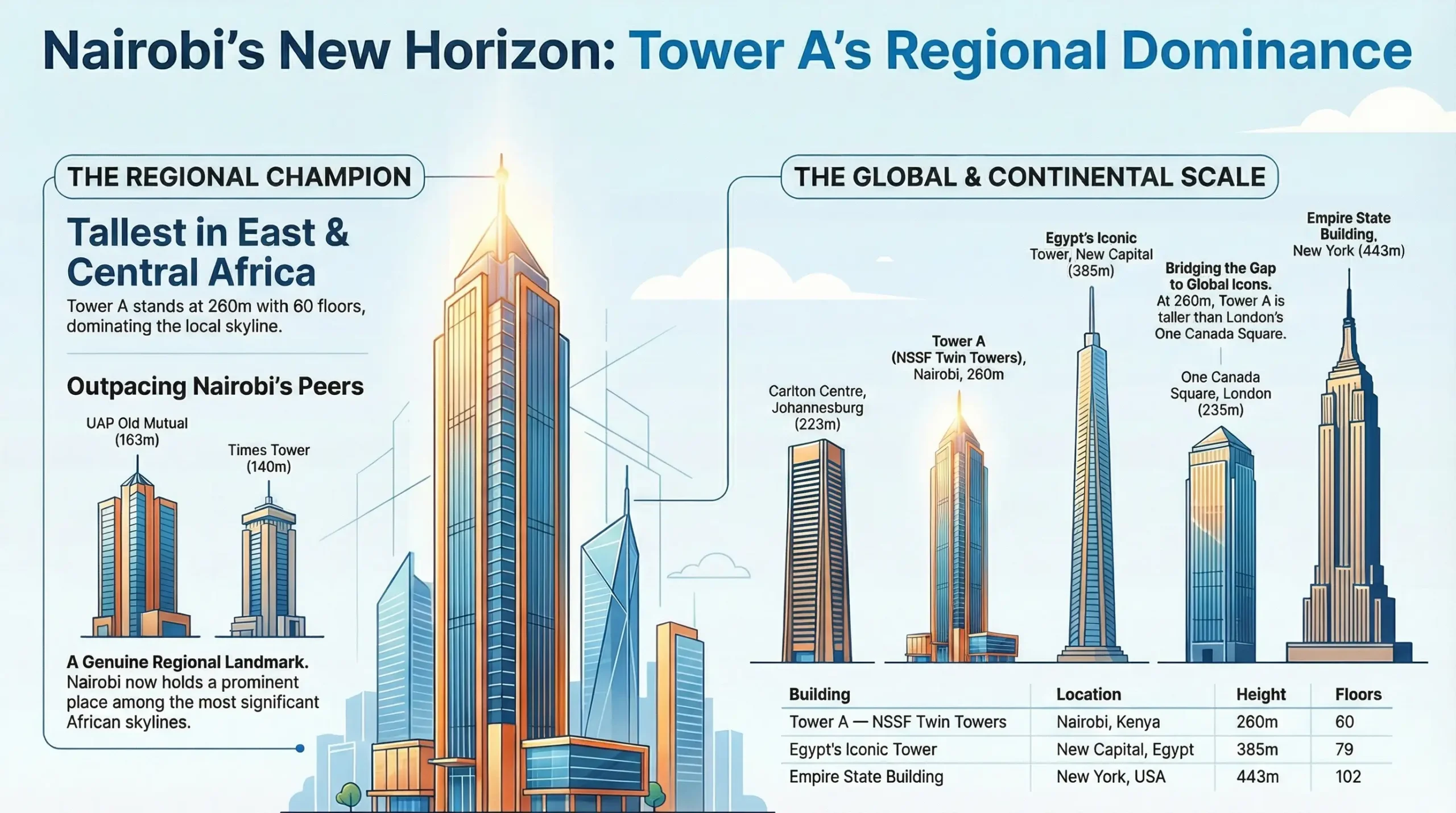
The honest takeaway: Tower A is not a global supertall. But for East and Central Africa, it is a genuine landmark, and the most significant commercial building in this region by a significant margin. Nairobi earns a place on the list of African skylines that matter.
Is the NSSF Twin Towers a Green Building?
Quick Answer
Yes — this is one of the most comprehensively specified green buildings in East Africa. Solar PV panels will generate 51.5% of the building's electricity. Motion-sensing taps cut water consumption by up to 85%. A dual water system combines mains supply with harvested rainwater for toilets, cleaning, and irrigation. The architectural mid-section sky opening between the towers enables natural cross-ventilation, reducing air conditioning load. EV charging infrastructure is built into the basement. Annual environmental audits to NEMA are a legal requirement throughout the building's operational life. These are not add-ons, they are embedded in the design from the ground up.
Sustainability in a building this size is not a badge. It is an engineering decision that directly affects the cost of running the building and the return NSSF earns on its Ksh 30 billion investment. Here is a breakdown of each green system, what it does, and what it takes to keep it delivering.
Water Conservation — Rainwater Harvesting and Smart Fixtures
The building operates a dual water reticulation system. Mains water from Nairobi City Water and Sewerage Company (NCWSC) handles drinking water and high-hygiene uses. Harvested rainwater — collected from the roof and podium surfaces — is stored in on-site tanks and reticulated separately for toilet flushing, floor cleaning, and landscape irrigation.
The EIA confirms that Nairobi’s existing sewerage infrastructure is “largely insufficient” to absorb the volume generated by a building of this scale. The rainwater harvesting system partly addresses this: water that is collected and reused on-site does not enter the sewerage network.
Motion-sensing taps: All taps and shower fittings specified in the design are sensor-activated. The EIA projects a reduction in water consumption of up to 85% compared to conventional fittings. Across hundreds of bathrooms in offices, a hotel, and residential units, this translates to a very large reduction in the monthly water bill.
Low-flow WCs, sensor-activated urinals, and waterless urinals in high-traffic zones are part of the same specification. The cumulative effect is a building that uses a fraction of the water a comparable conventional building would.
Natural Ventilation and Passive Cooling
The most visible sustainability feature of the NSSF Twin Towers is the mid-section sky opening between the two towers, the architectural void built into the mid-height of the complex. This is not purely aesthetic. It is a passive ventilation strategy.
The opening allows prevailing winds to channel through the building, creating a natural cross-flow that reduces heat build-up in the upper floors and common areas. In Nairobi’s climate, where temperatures are moderate year-round, effective natural ventilation can significantly reduce the load on mechanical air conditioning.
The layered, terraced facade, inspired by the Great Rift Valley, also creates zones of shade across different elevations at different times of day. Reducing direct solar gain on the glass facade reduces cooling demand. Taken together, the architectural form of the building is doing active environmental work.
E-Mobility — EV Charging Infrastructure
The basement parking levels include provision for electric vehicle (EV) charging infrastructure. Kenya’s EV market is still early-stage, but the trajectory is clear: from government policy on e-mobility to the growing number of electric vehicles imported through Mombasa, the demand for charging points in commercial buildings is rising.
Building EV charging into the basement at design stage costs a fraction of retrofitting it later. For a building that will be operational through the 2030s and beyond, this is the right call. Premium tenants and hotel guests arriving in EVs will expect charging to be available. Not providing it is a competitive disadvantage in the Grade A market.
Waste Management — Segregation and Compliance
The EIA specifies a structured waste management system in line with the Sustainable Waste Management Act 2022. This requires waste to be segregated at source into three streams: organic waste, recyclable materials (paper, plastic, metal, glass), and hazardous waste (oils, chemicals, fluorescent lamps).
Hazardous waste must be stored in designated, labelled containment areas with secondary containment for spills. Disposal must be handled exclusively by NEMA-licensed waste contractors. General waste goes to licensed municipal disposal. The building specification includes dedicated waste rooms on each floor and a central waste holding area at podium level.
Non-compliance with the 2022 Act carries financial penalties. More practically, inadequate waste management in a premium mixed-use building creates health, hygiene, and reputational problems, all of which hit tenant satisfaction and ultimately rental income.
The Legal Compliance Framework
Environmental Management and Coordination Act (EMCA): NSSF is legally required to submit annual environmental audits to NEMA throughout the building’s operational life. These audits cover energy use, water consumption, waste management, emissions, and compliance with the conditions attached to the EIA approval. They cannot be delegated to a junior administrator. They require documented performance data across all systems.
Climate Change Act 2016: Kenya’s Climate Change Act requires large commercial developments to report on their energy performance and greenhouse gas emissions. This is a national obligation, not a voluntary standard. The building’s solar PV system and BMS data feed directly into this reporting requirement.
Sustainable Waste Management Act 2022: Governs the waste segregation, handling, and disposal requirements described above. Any breach, including using non-licensed waste handlers or failing to segregate, attracts regulatory action.
OSHA 2007: The Occupational Safety and Health Act governs workplace conditions across all occupied floors. Fire drills, emergency evacuation procedures, lift safety certificates, and electrical safety inspections all fall under this framework.
LEED and Green Star potential: The building’s specification does not explicitly commit to a LEED or Green Star certification, but the combination of solar PV coverage, water conservation measures, natural ventilation, EV infrastructure, and waste systems would likely qualify for a credible green building rating. Pursuing certification would be a marketing asset for NSSF in attracting premium tenants who have ESG reporting obligations.
Green building credentials in the design phase and green building performance in the operational phase are two very different things. The gap between them is exactly where professional facilities management earns its fee.
What Will the NSSF Twin Towers Do to Nairobi's CBD?
Quick Answer
The project brings significant economic activity back to a CBD that has been losing businesses to Westlands and Upper Hill for over a decade. It creates 500+ direct jobs, activates the CBD after 5pm through hotel guests and residents, and signals institutional confidence in the city centre. The challenges are equally real: 1,150 parking bays at one of Nairobi's most congested intersections, pressure on a sewerage system the EIA describes as "largely insufficient," and a Grade A office market that was already in oversupply before this project broke ground.
The Positive Impact
Jobs and economic activity. The project creates approximately 500 direct jobs on day one, with thousands more during the three-year construction phase. Indirect employment through supply chains multiplies that number. Tourism grows through the 56th floor observation deck and conference facilities, which attract MICE tourism (Meetings, Incentives, Conferences, Exhibitions) back to the city centre. Forex earnings from business travel and hospitality follow.
24-hour CBD activation. The hotel and serviced apartments mean the CBD does not die at 5pm. Guests, residents, and visitors create demand for food, retail, and services. This is exactly the live-work-play environment that the CBD has been missing as firms relocated to Westlands and Upper Hill.
The confidence signal. When Kenya’s largest pension fund commits Ksh 30 billion to the CBD, it tells other institutional investors that the city centre is worth backing. That kind of signal has a multiplier effect on surrounding development and land values.
Land value uplift. An anchor development of this scale raises property values in the surrounding streets. Existing owners in the area benefit.
The Challenges to Watch
Traffic at Kenyatta/Uhuru. The EIA acknowledges that the development adds significant traffic pressure to one of Nairobi’s busiest junctions. 1,150 parking bays generate substantial vehicle movements. The EIA calls for auxiliary lanes, traffic marshals, and a full Traffic Management Plan. Whether those measures will be sufficient during operations remains to be seen.
Sewerage strain. Nairobi’s sewerage infrastructure is already under pressure. The EIA explicitly states that the capacity of the existing sewerage system in Nairobi City has become “largely insufficient.” A 164,495 m2 mixed-use complex with a hotel, residential units, offices, and retail adds substantial load. This is a city infrastructure problem that one building cannot solve.
Three years of construction disruption. Excavation and piling at a major CBD junction means noise, dust, and traffic diversions for years. The businesses on Kenyatta Avenue will feel this from day one of construction.
The Grade A office oversupply question. As Business Daily has reported, Westlands is already choking under commercial development pressure. Nairobi’s Grade A office market had a vacancy problem before this project was announced. Adding a large volume of new premium office space requires a clear tenancy strategy from NSSF, otherwise, the CBD absorbs more empty floors.
Informal economy displacement. Rising land values and a premium anchor development will apply gentrification pressure to the area. The hawkers, small traders, and informal businesses that have operated in this part of the CBD will face displacement, either directly or through rising costs nearby.
Managing 164,000 Square Metres — What It Actually Takes

I want to talk about something that gets very little attention in all the coverage of this project: what happens after the towers open.
NSSF has set a minimum return target of 12% on this investment. That return does not come from the architecture. It comes from the quality of day-to-day operations — how the building is run, maintained, tenanted, and managed.
A building of this scale and complexity needs professional commercial property management in Nairobi that goes well beyond what most property managers here are set up to deliver.
Hard FM — The Technical Backbone
Hard Facilities Management covers everything structural and mechanical. In a building like this, that means lift management across 60 and 35 floors, lift downtime in a Grade A office tower is a lease termination trigger. It means BMS (Building Management System) operation: the central nervous system controlling HVAC, lighting, access control, and energy monitoring.
It means generator management, because Nairobi’s power grid is not infallible and a hotel and serviced apartments cannot tolerate outages. Solar PV maintenance to actually deliver the promised 51.5% energy coverage. Fire suppression systems, sprinklers, and dry risers, all maintained to OSHA 2007 standards. These are not set-and-forget systems. They require scheduled preventative maintenance, annual testing, and rapid response when something fails.
Soft FM — The Tenant Experience
Soft FM covers everything the tenant actually sees and feels. Cleaning 164,495 m2 is a logistics operation: shift management, equipment, consumables, and quality control across office floors, hotel rooms, residential corridors, retail units, the car park, and external areas.
Security is four different briefs in one building. The car park, hotel lobby, residential access points, and office lobbies each require different protocols and different levels of response. Waste management must comply with the Environmental Management and Coordination (Waste Management) Regulations 2024, colour-coded segregation, NEMA-licensed collectors, and performance tracking.
The Multi-Use Challenge
This is where buildings like this most often fail. Managing a single-use office block is straightforward. Managing offices, a hotel, serviced apartments, and retail under one roof, with shared infrastructure, is a different problem.
Office tenants operate 8am to 6pm and want quiet, reliable, predictable services. Hotel guests expect 24-hour responsiveness and hospitality-grade standards. Residential tenants want security, privacy, and fair service charges. Retail operators want flexible access and footfall.
The service charge apportionment, who pays for what, and how much, is one of the most contentious issues in managing shared-use buildings in Nairobi. Get it wrong and you have disputes with every tenant class from year one. Get it right and you have a building that runs cleanly.
Compliance Is Ongoing, Not a One-Off
The EIA commits NSSF to annual environmental audits submitted to NEMA. The Climate Change Act 2016 requires energy performance reporting. The Sustainable Waste Management Act 2022 mandates specific waste handling practices. OSHA 2007 governs workplace safety. None of these obligations end at handover. Someone has to own them, report on them, and ensure the building stays in compliance throughout its operational life.
If Simpl Were Appointed — How We Would Run This Building
At Simpl Property Management, we manage residential blocks, estates and gated communities, Airbnb and short-term rentals and commercial properties across Nairobi. A building of this scale is a different order of magnitude, but the principles we apply every day are the same.
Here is how I would think about it.
The first priority is pre-handover. We would not wait for the keys. The FM partner should be embedded during Stage 9: pre-commissioning, working alongside the CRBC team. That means snagging every floor, witnessing every system test, and building the maintenance schedule and vendor contracts before a single tenant signs a lease. Most buildings in Nairobi receive their FM team after handover. By then, it is already too late to fix what was missed.
The second priority is the gap between the EIA’s green promises and operational reality. The solar PV system, rainwater harvesting, and BMS are only assets if they are maintained. We would establish baseline performance benchmarks at handover and track them monthly. When performance drops, we act before it becomes a cost or a compliance issue.
The third priority is tenant communication. NSSF needs 12% from this asset. Empty floors and tenant disputes kill that return faster than any operational failure. Transparency on service charges, responsiveness to maintenance requests, and proactive communication with tenants are not soft skills in this context, they are financial performance drivers.
A building this ambitious deserves management that matches the ambition.
Talk to Us
If you own or manage commercial property in Nairobi and want to talk about what professional property management looks like, reach out to Simpl. We bring the same rigour to every property we manage, whether it's a 26-unit apartment block or a 60-floor tower.
Talk to us about your property or find us on Google and read what our clients say about how we work.
Final Thoughts
The NSSF Twin Towers is the most significant real estate development in East Africa in a generation. It is going to change Nairobi’s skyline, bring institutional capital back to the CBD, and create real economic activity in a part of the city that has been underperforming for years.
But the project’s success, financial and physical, will be determined by what happens after the last crane comes down. A Ksh 30 billion investment with a 12% return target needs management that is as serious as the ambition behind it.
Three things to remember: great buildings do not run themselves. The CBD revival is real, but so are the infrastructure pressures that come with it. And the gap between green building design and green building performance is exactly where professional facilities management earns its keep.
Frequently Asked Questions
When will the NSSF Twin Towers be completed?
NSSF expects construction to take approximately three years from groundbreaking. If regulatory approvals including NEMA clearance and KCAA height sign-off are finalised by mid-2026, the project is expected to be completed and handed over by late 2028 to early 2029.
How tall is the NSSF Twin Towers and is it really the tallest in East Africa?
Tower A stands 260 metres across 60 floors. Tower B is 140 metres across 35 floors. Tower A will be the tallest building in East and Central Africa once complete. It is nearly double the height of Times Tower (140 metres), and exceeds the Carlton Centre in Johannesburg (223 metres). Africa’s overall tallest building is Egypt’s Iconic Tower at 385 metres in the New Administrative Capital, which is why the claim is “East and Central Africa,” not “all of Africa.”
Who is building the NSSF Twin Towers and who designed it?
The contractor is the China Road and Bridge Corporation (CRBC), part of the CCCC Third Highway Engineering Co. Ltd Consortium. The designer is the China Academy of Building Research (CABR). The design advisor is Surbana Jurong of Singapore. The Kenyan project team includes Architect Engineer Francis Ikere of Shelter Solutions Ltd and Structural Engineer Eng. Wilson Wamahiu Munene.
What will be inside the NSSF Twin Towers?
The development includes premium office spaces, a business hotel, serviced residential apartments, retail outlets, conference facilities, an observation deck on the 56th floor of Tower A, and basement and podium parking for approximately 1,150 vehicles. The full use-per-floor breakdown for each tower has not yet been publicly confirmed, this page will be updated when it is.
What does facilities management mean and why does a building like this need it?
Facilities management (FM) covers the operation, maintenance, and management of a building once it opens. For a mixed-use building like the NSSF Twin Towers, FM includes hard services (lifts, HVAC, generators, solar PV, fire systems), soft services (cleaning, security, waste management), tenant management across multiple occupier types, service charge management, and ongoing regulatory compliance. Without professional FM, the building’s technical systems degrade, tenants leave, and the investment return suffers. NSSF has set a minimum 12% return target, that return lives in the quality of day-to-day operations.
What are the green building features of the NSSF Twin Towers?
The NSSF Twin Towers includes six core sustainability systems. First, solar PV panels sized to generate 51.5% of the building’s electricity needs, one of the highest coverage ratios for a high-rise commercial building in East Africa. Second, a dual water reticulation system: mains supply for drinking water and high-hygiene uses, plus a separate rainwater harvesting system for toilets, floor cleaning, and irrigation. Motion-sensing taps across all bathroom and kitchen fittings reduce water consumption by up to 85% compared to conventional fixtures.
Third, the architectural mid-section sky opening between the two towers enables natural cross-ventilation, reducing air conditioning load and improving air quality on the upper floors. Fourth, occupation sensors in office and common areas automatically reduce lighting and HVAC output when spaces are unoccupied, typically delivering 20% to 30% energy savings over a conventional system. Fifth, EV charging infrastructure is built into the basement parking levels, supporting Kenya’s growing e-mobility adoption. Sixth, a structured waste management system in compliance with the Sustainable Waste Management Act 2022 mandates source segregation into organic, recyclable, and hazardous streams with NEMA-licensed disposal.
Taken together, the building is legally required to submit annual environmental performance audits to NEMA under EMCA, report energy consumption under the Climate Change Act 2016, and comply with OSHA workplace safety standards throughout its operational life. The sustainability features are not optional extras, they are embedded in the design and carry ongoing compliance obligations.